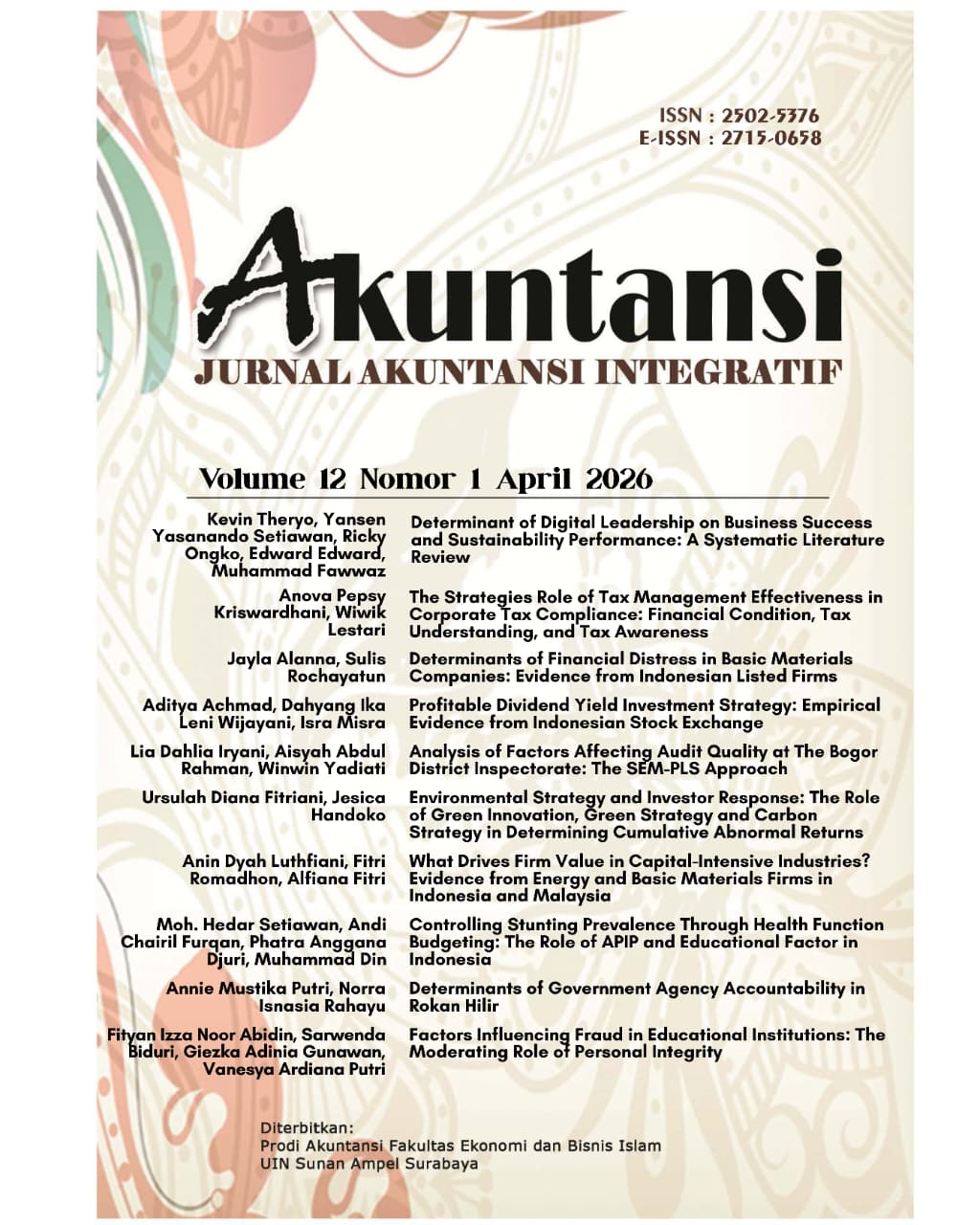
Factors Influencing Fraud in Educational Institutions: The Moderating Role of Personal Integrity
DOI:
https://doi.org/10.29080/jai.v12i1.2459Keywords:
Feeling Finansial Accountability, Religiosity, Morality, Personal IntegrityAbstract
Purpose: The purpose of this research is to analyze the influence of a sense of financial accountability, religiosity, and morality on fraud in educational institutions, with personal integrity as a moderating variable. Previous research has shown inconsistent results regarding the influence of a sense of financial accountability, religiosity, and morality on fraud; therefore, personal integrity was used as a moderating variable because it can determine an individual’s consistency in applying moral values and honesty, thereby helping to explain the differences in previous research findings.
Methodology/approach: This research uses a quantitative approach based on primary data obtained through the distribution of questionnaires to teachers, financial directors, treasurers, and school administrators at Amal Usaha Muhammadiyah Pendidikan Sepanjang, with a total of 36 respondents. Data analysis was conducted using Partial Least Squares (PLS) with the assistance of SmartPLS.
Findings: The results indicate that a sense of financial accountability and religiosity have a positive and significant effect on fraud prevention. Conversely, morality does not have a significant effect on fraud. Personal integrity was found to act as a partial moderator, with only one interaction showing a significant effect.
Practical implications: This research emphasizes that educational institutions need to strengthen their oversight systems and culture of accountability in order to minimize the potential for fraud within these institutions.
Originality/value: This research contributes to the development of a fraud prevention model for educational institutions based on individual values by positioning personal integrity as a factor that reinforces the relationship between accountability, religiosity, and fraud in educational institutions.
Downloads
References
Ajzen, I. (1991). The theory of planned behavior. Organizational Behavior and Human Decision Processes, 50(2), 179–211. https://doi.org/10.1016/0749-5978(91)90020-T
Anzwar, D., & Sholihah, R. A. (2023). Moderasi Moralitas Individu pada Determinan Pencegahan Kecurangan di BUMD Kota Pekalongan. Jurnal Akuntansi Publik, 3(1), 25–40.
Asma, A., & Biduri, S. (2023). Determinan Pressure, Opportunity, Rationalization, Gender, dan Religiusitas terhadap Kecurangan Akademik pada saat Pembelajaran Hybrid. Innovative Technologica: Methodical Research Journal, 2(4), 1–12. https://doi.org/10.47134/innovative.v2i4.7
Bai, R. (2023). Impact of financial literacy, mental budgeting and self control on financial wellbeing: Mediating impact of investment decision making. PLoS ONE, 18(11 November). https://doi.org/10.1371/journal.pone.0294466
Biduri, S., Fitriyah, H., & Febriana, P. (2022). Pencegahan Fraud dalam pengelolaan alokasi dana desa. Owner, 6(4), 4021–4036. https://doi.org/10.33395/owner.v6i4.1085
Biduri, S. O. and S. (2024). Transparent governance: Unveiling accountability in village budget management. Indonesian Journal of Law and Economics Review, 4(1), 12–25.
Br, D., & Maria, E. E. (2022). Religiusitas dan Perilaku Kecurangan Akademik Mahasiswa di Masa Pandemi Covid-19. AFRE Accounting and Financial Review, 5(3), 321–330. https://jurnal.unmer.ac.id/index.php/afr
Cressey, D. R. (1953). Other People’s Money: A Study in the Social Psychology of Embezzlement. Free Press.
Dewi, N. F., Ferdous Azam, S. M., & Yusoff, S. K. M. (2019). Factors influencing the information quality of local government financial statement and financial accountability. Management Science Letters, 9(9), 1373–1384. https://doi.org/10.5267/j.msl.2019.5.013
Dwiyanti, D., Wicaksono, A. P. N., & Ulum, I. (2022). Internal Control System, Whistleblowing System, Organizational Commitment and Fraud Prevention: Individual Morality as A Moderating Variable. JAK (Jurnal Akuntansi) Kajian Ilmiah Akuntansi, 9(2), 172–188. https://doi.org/10.30656/jak.v9i2.4577
Dzomira, S. (2014). Internal Controls and Fraud Schemes in Not-For-Profit Organisations : A Guide for Good Practice. Research Journal of Finance and Accounting, 5(2), 118–126. https://www.iiste.org/Journals/index.php/RJFA/article/view/10685
Fadhila Nurmawaddah, I., & Munari. (2025). Dampak Kecerdasan Intelektual, Integritas, dan Academic-Self Efficacy Terhadap Academic Fraud Dengan Sikap Etis Mahasiswa Sebagai Variabel Moderasi. Jurnal Akuntasi Dan Keuangan Kontemporer (JAKK), 8(2). https://doi.org/10.30596/jakk.v8i2.25593
Gaspar, M. R., Gabriel, J. P., Manuel, M. B., Ladrillo, D. S., Gabriel, E. R., & Gabriel, A. G. (2022). Transparency and Accountability of Managing School Financial Resources. Journal of Public Administration and Governance, 12(2), 102. https://doi.org/10.5296/jpag.v12i2.20146
Gusnardi, Riadi, R. M., & Hendripides. (2021). School Financial Management based on Accountability and Transparency. International Journal of Early Childhood Special Education, 13(2), 538–550. https://doi.org/10.9756/INT-JECSE/V13I2.211091
Herawaty, N., & Masbirorotni, A. (2022). The Impacts of the Fraud Diamond Dimension, Religiosity, and Misuse of Information Technology on Student Academic Dishonesty. IRJE |Indonesian Research Journal in Education| |Vol. 6| No. 2|Dec|Year 2022| 362.
Humphrey, E. A., O., E. A., & Praise, E. I. (2023). Fraud Diamond: Detecting Fraudulent Behaviours in a Firm. Journal of Corporate Governance Research, 7(1), 31. https://doi.org/10.5296/jcgr.v7i1.20405
Ilyas, M., & Umar, H. (2023). Faktor Morality Dan Sistem Informasi Akuntansi Pada Pencegahan Fraud Dana Desa. Jurnal Bisnis Dan Manajemen (JURBISMAN), 1(3). https://ejournal.lapad.id/index.php/jurbisman/article/view/277
Izza Noor Abidin, F., Arista Firana, R., & Biduri, S. (2025). Fraud Pentagon in Detecting Financial Statement Fraud. International Journal of Economic Integration and Regional Competitiveness, 2(2), 19–33. https://doi.org/10.61796/ijeirc.v2i2.324
Lewaherilla, M. (2021). Pengaruh Iklim Organisasi, Fasilitas Belajar dan Kompetensi IT terhadap Kinerja Guru SMK Setia Bhakti Tangerang Di Masa Pandemi Covid 19. Syntax Idea, 3(4), 867–882. https://doi.org/10.46799/syntax-idea.v3i4.1132
Lubis, N. F., Nasution, N. F., Harahap, M. S., Nasution, F. H., & Rambe, L. H. (2024). Analisis Pemanfaatan Laboratorium Ipa Dalam Pembelajaran Kimia Di Kelas Xi Sma Negeri 3 Padang Sidempuan. JURNAL MathEdu (Mathematic Education Journal), 7(1), 94–101. https://journal.ipts.ac.id/index.php/MathEdu/article/view/5364
Made Feri Cahyadi, & Edy Sujana. (2020). Pengaruh Religiusitas, Integritas, dan Penegakan Peraturan Terhadap Fraud pada Pengelolaan Keuangan Desa. Jurnal Ilmiah Akuntansi Dan Humanika, 10(2), 136–145. https://doi.org/10.23887/jiah.v10i2.25919
Nugroho, A. P., Biduri, S., Hariyanto, W., & Abidin, F. I. N. (2024). Gender Memoderasi Hubungan Love Of Money, Religiusitas, Moralitas terhadap Kecenderungan Fraud Accounting Dana Desa. JAI: Jurnal Akuntansi Integratif, 10(2), 40–60. https://10.29080/jai.v10i2.1056
Pering, I. M. A. A. (2023). KAJIAN ANALISIS JALUR DENGAN STRUCTURAL EQUATION MODELING (SEM) SMART-PLS 3.0. The Universal Declaration of Human Rights: A Common Standard of Achievement, 03(02), 251–264. https://doi.org/10.1163/9789004637542_017
Purnamasari, D. I. (2021). The impact of accountability, tranparency, and morality of village apparatus on fraud prevention in the management of allocated village funds. Journal of Business and Information Systems (e-ISSN: 2685-2543), 3(2), 137–144. https://doi.org/10.36067/jbis.v3i2.104
Puspitasari, D. (2023). Pengaruh Pengendalian Internal, Moralitas Individu, Dan Religiusitas Terhadap Fraud. Jurnal Ilmiah Akuntansi Kesatuan, 11(1). https://doi.org/10.37641/jiakes.v11i1.1619
Rachmadaniar, F. V., & Biduri, S. (2023). Analysis of Factors Tendency to Occurrence of Fraud. 1–9. http://dx.doi.org/10.21070/ups.2609
Rahman, K., & Yulian, T. N. (2021). Determinan fraud prevention dengan akuntabilitas sebagai variabel mediating. Inovasi, 17(4), 828–834. https://doi.org/10.30872/jinv.v17i4.10244
Ramandei, P., Rohman, A., Ratmono, D., & Ghozali, I. (2020). Interactions of financial assistance and financial reporting competency: Evidence from local government in Papua and West Papua Indonesia. International Journal of Financial Research, 11(1), 1–12. https://doi.org/10.5430/ijfr.v11n1p1
Ridwan, R., & Diantimala, Y. (2021). The positive role of religiosity in dealing with academic dishonesty. Cogent Business and Management, 8(1). https://doi.org/10.1080/23311975.2021.1875541
S. Biduri, H. Fitriyah, and P. F. (2022). Individual morality and internal control systems on fraud prevention in village fund management. Accounting and Public Finance Journal, 3(2), 95–107. https://doi.org/10.21532/apfjournal.v9i2.330
S. Hermawan, & Amirulloh. (2016). Metode Penelitian Bisnis Pendekatan Kuantitatif dan Kualitatif (Media Nurs).
Syahda, T. N., & Nurhadianto, T. (2023). Pengaruh Integritas, Moralitas, dan Religiositas Terhadap Pencegahan Kecurangan Pengelolaan Dana BOS. Prosiding Seminar Nasional, 47–55. https://jurnal.darmajaya.ac.id/index.php/PSND/article/view/3837%0A
Via, V. I. A., & Abidin, F. I. N. (2025). Whistleblowing and Islamic Ethics in Preventing Fraud. Indonesian Journal of Islamic Studies, 13(3), 1–17. https://doi.org/10.21070/ijis.v13i3.1785
Wardani, D. K., & Puspitasari, D. (2023). The Influence Of Religiosity On Accounting Student Academic Cheating. International Conference On Education, July, 771–778.
Wijayanti, W., & Santoso, S. (2022, September). The Effect Of Financial Literacy, Mental Accounting And Income Level On Consumption Behavior With Gender As A Moderating Variable (Study On Millennial Generation In Banyumas Regency). https://doi.org/10.4108/eai.10-8-2022.2320916
Wolfe, D. T., & Hermanson, D. R. (2004). FTE Penipuan Diamond: Mengingat Four Elements of Fraud. CPA Journal, 74(12), 38–42.
Yarsasi, S., Tahyudin, I., & Hariguna, T. (2025). Analisis Validitas dan Reliabilitas Kuesioner dengan Metode Partial Least Squares Structural Equation Modeling pada Aplikasi SMARTPLS. Jurnal Pendidikan Dan Teknologi Indonesia, 5(7), 1905–1913. https://doi.org/10.52436/1.jpti.885
Downloads
Published
How to Cite
Issue
Section
License
Copyright (c) 2026 Fityan Izza Noor Abidin, Sarwenda Biduri, Giezka Adinia Gunawan, Vanesya Ardiana Putri

This work is licensed under a Creative Commons Attribution-ShareAlike 4.0 International License.