
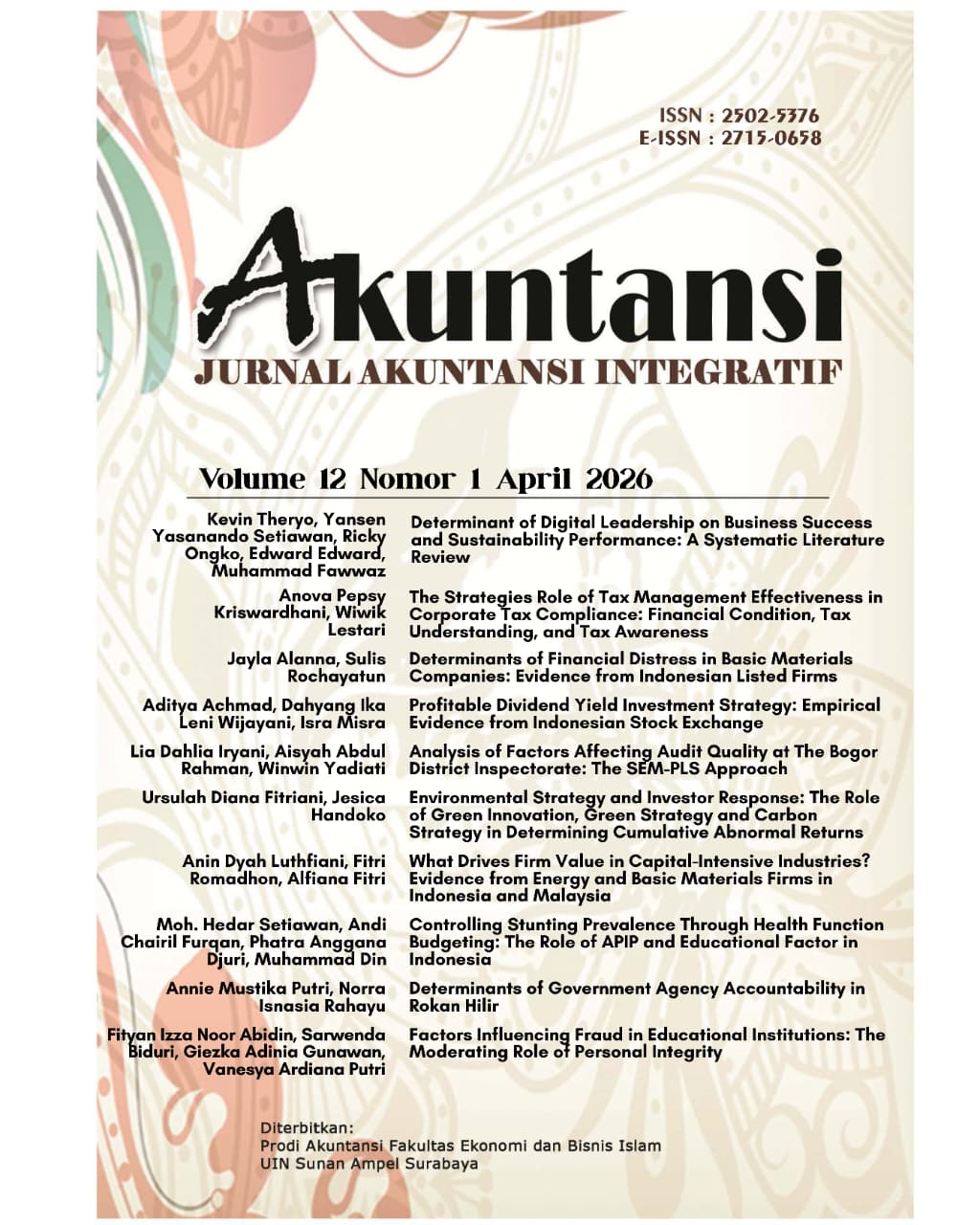
Analysis of Factors Affecting Audit Quality at The Bogor District Inspectorate: The SEM-PLS Approach
DOI:
https://doi.org/10.29080/jai.v12i1.2455Keywords:
Audit Quality, Bogor District Inspectorate, SEM-PLSAbstract
Purpose: Audit quality is a fundamental component of effective governance, particularly within the public sector, where internal supervisory bodies play a critical role in ensuring accountability and transparency. Recent corruption cases in the Bogor District have illuminated significant shortcomings in the internal audit mechanisms, thereby necessitating a comprehensive exploration of the factors that influence audit quality. This study aims to investigate the effects of education, professional experience, and professionalism on audit quality within the Bogor District Inspectorate.
Methodology/approach: Employing SEM-PLS, the study analyzed data obtained from a survey of 36 professional auditors.
Findings: The findings indicated that professional experience has a significant positive impact on audit quality, whereas education and professionalism do not exhibit statistically significant direct effects. These results suggested that, while academic qualifications and professional attitudes remain important, practical experience is a more decisive factor in enhancing audit quality.
Practical implications: The research provided meaningful guidance for public sector audit institutions aiming to improve audit effectiveness by strengthening the competencies of their auditors.
Originality/value: This study provides empirical evidence from a local government context, highlighting the dominant role of professional experience in determining audit quality. Future research is encouraged to explore potential mediating or contextual factors influencing these relationships.
Downloads
References
Al-faryan, M. A. S. (2024). Agency theory , corporate governance and corruption: an integrative literature review approach. Cogent Social Sciences, 10(1). https://doi.org/10.1080/23311886.2024.2337893
AlQatamin, K. I., & Salleh, Z. (2020). Audit quality: a literature overview and research synthesis. IOSR Journal of Business and Management (IOSR-JBM), 22(2), 56–66. https://doi.org/10.9790/487X-2202025666
Alsaeedi, A. M. A., & Kamyabi, Y. (2023). The impact of auditor experience and competence on audit quality with moderating role of auditors ethics: evidence from Iraq. Russian Law Journal, 11(11s), 112–128. https://doi.org/10.52783/rlj.v11i11s.1880
Alzoubi, E. S. S. (2016). Audit quality and earnings management : evidence from Jordan. Journal of Applied Accounting Research, 17(2), 170–189. https://doi.org/10.1108/JAAR-09-2014-0089
Becker, C. L., Defond, M. L., Jiambalvo, J., & Subramanyam, K. R. (1998). The effect of audit quality on earnings management. Contemporary Accounting Research, 15(1), 1–24. https://doi.org/10.1111/j.1911-3846.1998.tb00547.x
Bedard, J. C., & Biggs, S. F. (1991). Pattern recognition, hypotheses generation, and auditor performance in an analytical task. The Accounting Review, 66(3), 622–642. http://www.jstor.org/stable/247813
Bonner, S. E., & Lewis, B. L. (1990). Determinants of auditor expertise. Journal of Accounting Research, 28(May), 1–20. https://doi.org/10.2307/2491243
Chi, W., Myers, L. A., Omer, T. C., & Xie, H. (2017). The effects of audit partner pre-client and client-specific experience on audit quality and on perceptions of audit quality. Review of Accounting Studies, 22, 361–391. https://doi.org/10.1007/s11142-016-9376-9
Chin, W. W. (1998). The Partial Least Squares approach to Structural Equation Modeling. Modern Methods for Business Research, 295–336.
Christensen, B. E., Glover, S. M., & Wolfe, C. J. (2014). Do critical audit matter paragraphs in the audit report change nonprofessional investors’ decision to invest ? Auditing: A Journal of Practice & Theory, Forthcoming. https://doi.org/10.2307/2491243
Chu, J., Florou, A., & Pope, P. F. (2021). Auditor university education: does it matter? European Accounting Review, 31(4), 787–818. https://doi.org/10.1080/09638180.2020.1866633
Cunningham, L. M., & Stein, S. E. (2025). The Role of External Auditors in the Financial Reporting Process. In Handbook on the Financial Reporting Environment edited by Weili Ge, Allison Koester, and Sarah McVay (pp. 1–38). Edward Elgar Publishing Ltd. https://doi.org/10.4337/9781800888685.00025
DeAngelo, L. E. (1981). Auditor size and audit quality. 3(July), 183–199.
Defond, M. L., & Jiambalvo, J. (1993). Factors Related to Auditor-Client Disagreements over Income-Increasing Accounting Methods*. Contemporary Accounting Research, 9(2), 415–432. https://doi.org/10.1111/j.1911-3846.1993.tb00889.xDigital Object Identifier (DOI)
DeFond, M., & Zhang, J. (2014). A review of archival auditing research. Journal of Accounting and Economics, 58(2–3), 275–326. https://doi.org/10.1016/j.jacceco.2014.09.002
Diamantopoulos, A., & Siguaw, J. A. (2000). Introducing LISREL. SAGE Publications Ltd. https://doi.org/https://doi.org/10.4135/9781849209359
Dopuch, N., King, R. R., & Schwartz, R. (2003). Independence in appearance and in fact: an experimental investigation. Contem, 20(1), 79–114. https://doi.org/10.1506/9B5D-HLLP-BBQE-8N3FDigital Object Identifier (DOI)
Eferakeya, I., & Edgars, P. (2021). Audit and the Role of Auditing : An Exposition of the Underpinning Theories. Test Engineering and Management, 84, 226–248.
Ferdyansah, N., Yulinartati, & Nuha, G. A. (2023). Pengaruh profesionalisme, pengalaman kerja, dan pendidikan auditor eksternal terhadap kualitas audit. Jurnal Mahasiswa Entrepreneur (JME), 2(3), 494–509. 10.36841/jme.v2i3.3244
Fornell, C., & Larcker, D. F. (1981). Evaluating structural equation models with unobservable variables and measurement error. Journal of Marketing Research, 18(1), 39–50. https://doi.org/10.2307/3151312
Francis, J. R. (2011). A framework for understanding and researching audit quality. Auditing: A Journal of Practice & Theory, 30(2), 125–152. https://doi.org/10.2308/ajpt-50006
Garson, G. D. (2016). Partial Least Squares: Regression and Structural Equation Models. Statistical Associates Publishers.
Hair, J. F., Hult, G. T. M., Ringle, C. M., & Sarstedt, M. (2021). A Primer on Partial Least Squares Structural Equation Modeling (PLS-SEM) (Third Edit). SAGE Publications Ltd.
Hall, M., Smith, D., & Langfield-Smith, K. (2005). Accountants’ commitment to their profession: Multiple dimensions of professional commitment and opportunities for future research. Behavioral Research in Accounting, 17(1), 89–109. https://doi.org/10.2308/bria.2005.17.1.89
Henseler, J., Ringle, C. M., & Sarstedt, M. (2015). A new criterion for assessing discriminant validity in variance-based structural equation modeling. Journal of the Academy of Marketing Science, 43(1), 115–135. https://doi.org/10.1007/s11747-014-0403-8
IAASB. (2011). Audit Qualit: An IAASB Perspective. International Auditing and Assurance Standarrd Board.
Khulsum, U., Suryanto, T., Ali, J., & Yudha, H. (2025). Breaking barriers in audit quality: The dynamic interactions of competence, time budget pressure, complexity, and motivation in Indonesia landscape. Social Sciences & Humanities Open, 12(February), 101905. https://doi.org/10.1016/j.ssaho.2025.101905
Kline, R. B. (2016). Principles and Practice of Structural Equation Modeling (Fourth Edi). Guilford Publications.
Knechel, W. R., Krishnan, G. V, Pevzner, M., Shefchik, L., & Velury, U. (2013). Audit quality: Insights from the academic literature. Auditing: A Journal of Practice & Theory, 32(1), 1–68.
Kompas. (2022). Kasus Suap Bupati Ade Yasin, Auditor BPK yang Korupsi Wajib Dihukum Berat. Kompas. https://nasional.kompas.com/read/2022/04/29/07040051/kasus-suap-bupati-ade-yasin-auditor-bpk-yang-korupsi-wajib-dihukum-berat?utm
Laporan Akuntabilitas Kinerja Instansi Pemerintahan Tahun 2023. (2023).
Libby, R., & Luft, J. (1993). Determinants of judgement performance in accounting settings: ability, knowledge, motivation, and environment. Accounting Organizations and Society, 18(5), 425–450. https://doi.org/10.1016/0361-3682(93)90040-D
Mautz, R. K., & Sharaf, H. A. (1961). The Philosophy of Auditing. American Accounting Association.
Mengiste, B. W. (2022). Agency Theory: Its Discourse and Practice in the Selected Public-Sectors. Journal of Social Sciences and Management Studies, 1(4), 34–43. 10.56556/jssms.v1i4.342
Nasution, D., & Östermark, R. (2012). The impact of social pressures , locus of control , and professional commitment on auditors’ judgment Indonesian evidence. Asian Review of Accounting, 20(2), 163–178. https://doi.org/10.1108/13217341211242204
Peraturan Bupati Kabupaten Bogor Nomor 57 Tahun 2020 Tentang Kedudukan, Susunan Organisasi, Tugas Dan Fungsi Serta Tata Kerja Inspektorat (2020). https://peraturan.bpk.go.id/Details/173623/perbup-kab-bogor-no-57-tahun-2020
Peraturan Menteri Pendayagunaan Aparatur Negara Dan Reformasi Birokrasi Nomor 48 Tahun 2022 Tentang Jabatan Fungsional Auditor (2022). https://www.peraturan.go.id/id/permenpanrb-no-48-tahun-2022?utm
Peraturan Pemerintah Republik Indonesia Nomor 60 Tahun 2008 Tentang Sistem Pengendalian Intern Pemerintah (2008). http://51.79.208.232/bitstream/123456789/221/1/NOMOR 60 TAHUN 2008_PENGENDALIAN INTERNAL.pdf
Rahman, S.-, Chen, S., Al-faryan, M. A. S., Ahmad, I., Hussain, R. Y., & Saud, S. (2023). Audit services and financial reporting quality: The role of accounting expertise auditors. Cogent Business & Management, 10(1), 1–25. https://doi.org/10.1080/23311975.2022.2164142
Risanti, T. P., Aswar, K., Jumansyah, & Wirman. (2021). Determinants influencing the audit quality: Empirical evidence from Indonesia. Universal Journal of Accounting and Finance, 9(6), 1265–1272. https://doi.org/10.13189/ujaf.2021.090606
Rumimpunu, M. R., Masruddin, Ansar, M., & Tenripada. (2024). The influence of professionalism, independence, and auditor experience on audit judgment. Journal of Governance, Taxation, and Auditing, 3(2), 80–91.
Sitorus, T., Hendratono, T., & Fransisca, N. (2020). The factors affecting audit quality. Journal of Economics, Business, and Accountancy Ventura, 23(2), 243–253. https://doi.org/10.14414/jebav.v23i2.2137
Suyono, E., & Hariyanto, E. (2012). Relationship between internal control, internal audit, and organization commitment with good governance: Indonesian case. China-USA Business Review, 11(9), 1237–1245.
Tavakol, M., & Dennick, R. (2011). Making sense of Cronbach’s alpha. International Journal of Medical Education, 27(2), 53–55. https://doi.org/10.5116/ijme.4dfb.8dfd
Wang, J., Cheng, H., & Qiao, K. (2025). Does experience matter? An examination of individual Auditor’s experience on executive implicit corruption. Pacific-Basin Finance Journal, 89.
Yulianti, Chandrarin, G., & Supanto, F. (2022). Effect of ethics and professionalism on audit quality: A moderating role of dysfunctional audit behavior. Problems and Perspectives in Management, 20(3), 529–539. https://doi.org/10.21511/ppm.20(3).2022.42
Downloads
Published
How to Cite
Issue
Section
License
Copyright (c) 2026 Lia Dahlia Iryani, Aisyah Abdul Rahman, Winwin Yadiati

This work is licensed under a Creative Commons Attribution-ShareAlike 4.0 International License.