
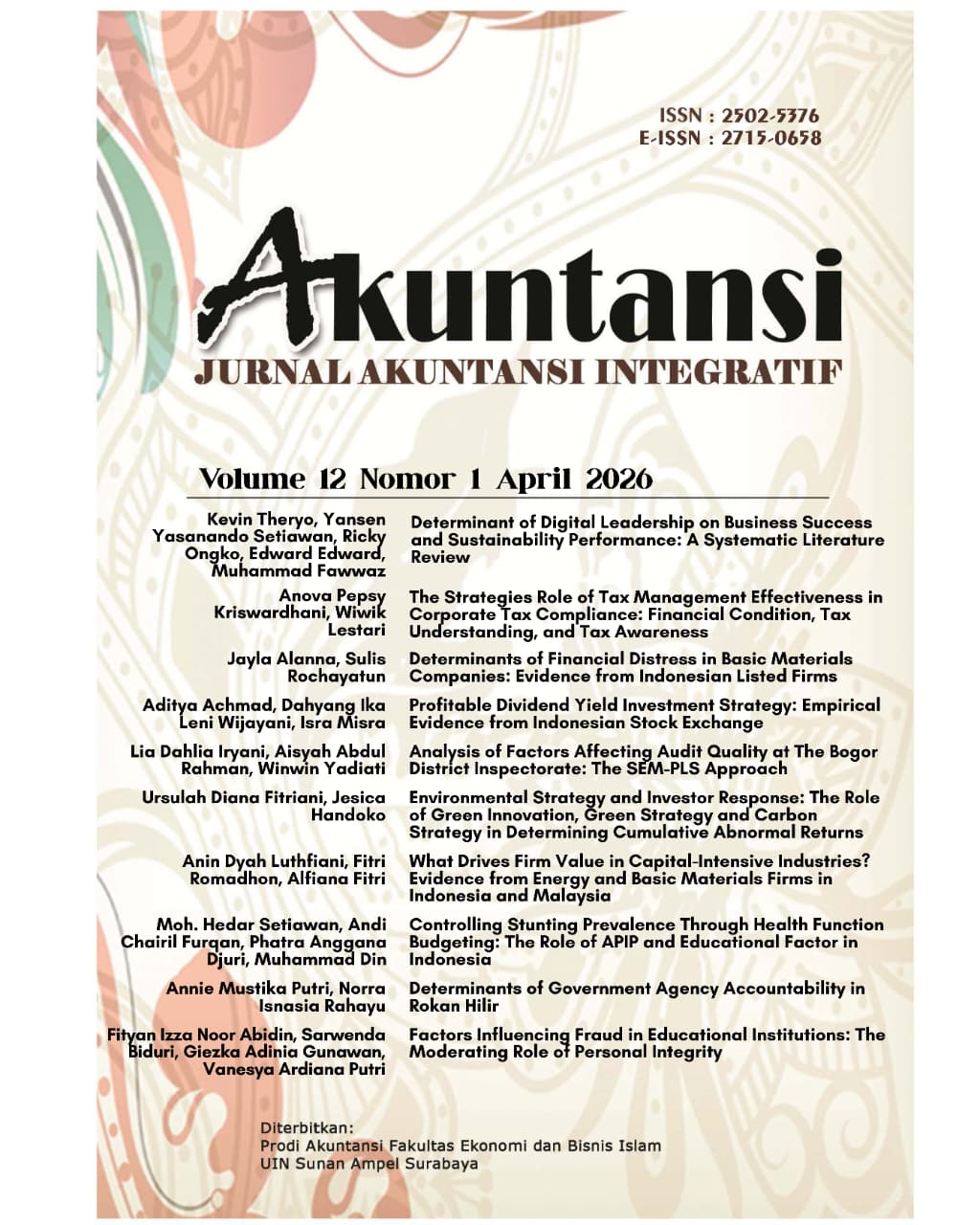
Environmental Strategy and Investor Response: The Role of Green Innovation, Green Strategy and Carbon Strategy in Determining Cumulative Abnormal Returns
DOI:
https://doi.org/10.29080/jai.v12i1.2436Keywords:
Green Innovation, Green Strategy, Carbon Strategy, Cumulative Abnormal ReturnAbstract
Abstract
Purpose: Environmental concern can enhance a company’s competitive advantage and reputation, influencing investor assessments. In Indonesia, rising carbon emissions and stakeholder pressure encourage firms to adopt green innovation and carbon strategies to reduce environmental impact, increase corporate value, and affect market reactions.
Methodology/approach: This study is quantitative, and purpose to analyze the factors that influence cumulative abnormal return (CAR). The independent variables are green innovation, green strategy, and carbon strategy, while firm size and profitability are used as control variables. Secondary Data were collected from IDX-listed energy, automotive, and transportation companies during 2021–2024. The sample was selected using purposive sampling and analyzed using multiple linear regression via SPSS 30.
Findings: The results indicate that green innovation has influence on CAR, green innovation is able to create a high level of competitiveness for firms through productivity optimization and cost efficiency. Likewise, green strategy does not influence on CAR, because investors do not yet fully value or understand it as a source of long-term financial value. In contrast, carbon strategy positively influences CAR, companies proactively implementing carbon strategy are viewed as better prepared for future carbon emissions regulation and, more capable of managing environmental risk.
Practical implications: Sustainability requires significant investment in human and financial resources, with benefits that are indirect and often only visible in the long term.
Originality/Value: The government as a regulator needs to require public companies in Indonesia to implement sustainability strategies to support sustainable development.
Downloads
References
Adilah, F., & Wiliyanti, R. (2025). Pengaruh Profitabilitas, Financial Distress, Makroekonomi dan Ukuran Perusahaan terhadap Return Saham pada Perusahaan Sektor Transportasi dan Logistik yang Terdaftar di Bei Periode 2019-2023. RIGGS: Journal of Artificial Intelligence and Digital Business, 4(3), 4005–4014.
https://doi.org/10.31004/riggs.v4i3.2481
Alshammari, K. H., & Alshammari, A. F. (2023). Green Innovation and Its Effects on Innovation Climate and Environmental Sustainability : The Moderating Influence of Green Abilities and Strategies.
https://doi.org/10.3390/su152215898
Andrian, T., & Kevin. (2021). Determinant Factors of Carbon Emission Disclosure in Indonesia. Journal of Southwest Jiaotong University, 56(1).
https://doi.org/10.35741/issn.0258-2724.56.1.32
Andriopoulos, Plakas, & Birbas, P. (2024). Design of a Prosumer-Centric Local Energy Market: An Approach Based on Prospect Theory. IEEE Access, 12, 32014–32032. https://doi.org/10.1109/ACCESS.2024.3370040
Anggrainy, Rosini, & Nofryanti. (2025). Reaksi Pasar Memoderasi Opsi Pertumbuhan Dan Publik Kepemilikan Terhadap Kinerja Keberlanjutan. 5(2), 286–298.
https://journal.moestopo.ac.id/index.php/jakpi
Asyari, S., & Arieftiara. (2022). Investors React to Disclosure of Carbon Emissions. 4(1), 59–76. https://doi.org/10.25105/ijca.v4i1.13911
Brown, W. (1985). Using daily stock returns: The case of event studies. Journal of Financial Economics, 14(1), 3–31.
Cahyaningtyas, S. R., Isnaini, Z., & Ramadhani, R. S. (2022). Green Corporate Social Responsibility: Green Innovation Dan Nilai Perusahaan. Jurnal Aplikasi Akuntansi, 6(2), 87–108. https://doi.org/10.29303/jaa.v6i2.137
Chen, Lai, & Wen. (2006). The Influence of Green Innovation Performance on Corporate Advantage in Taiwan. Business Ethics, 67, 331–339.
https://doi.org/10.1007/s10551-006-9025-5
Dai, D., & Xue, Y. (2022). The Impact of Green Innovation on a Firm’s Value from the Perspective of Enterprise Life Cycles. Sustainability (Switzerland), 14(3). https://doi.org/10.3390/su14031226
Damert, M., Paul, A., & Baumgartner, R. J. (2017). Exploring the determinants and long-term performance outcomes of corporate carbon strategies. Journal of Cleaner Production, 160, 123–138. https://doi.org/10.1016/j.jclepro.2017.03.206.
Dewi, R. R., & Rahmianingsih, A. (2020). Meningkatkan Nilai Perusahaan Melalui Green Innovation dan Eco-Effisiensi. 12(2).
https://doi.org/10.35313/ekspansi.v12i2.2241
Erlangga, C. M., Fauzi, A., & Sumiati, A. (2021). Penerapan Green Accounting dan Corporate Social Responsibility Disclosure Terhadap Nilai Perusahaan Melalui Profitabilitas. Akuntabilitas, 14(1), 61–78. https://doi.org/10.15408/akt.v14i1.20749
Fathoni, M. I. R, Shintyamani, Y. S, and Dianawati, W. Pengaruh Green Product Innovation terhadap Nilai Perusahaan melalui Return on Asset. Jurnal Akuntansi dan Ekonomika, Vol. 15 No.1, Juni 2025. http://ejurnal.umri.ac.id/index.php/jae.
Flammer, C. (2013). Corporate social responsibility and shareholder reaction: The environmental awareness of investors. Academy of Management Journal, 56(3), 758–781.
Florackis, C., Muktadir-al-mukit, D., Sainani, S., Zhang, J., St, H., & Sheffield, S. (2025). Journal of International Financial Markets , Stock market reaction to mandatory carbon disclosure announcements : The role of institutional investors. Journal of International Financial Markets, Institutions & Money, 99, 102113.
https://doi.org/10.1016/j.intfin.2025.102113
Gendy, N. S. El, Abo, A. M. R. M. A., & Khair, E. (2025). Carbon dioxide valorization : paving the way for climate change mitigation and a sustainable future. In International Journal of Environmental Science and Technology (Vol. 22, Issue 16). Springer Berlin Heidelberg. https://doi.org/10.1007/s13762-025-06711-y
Ghozali dan Chariri. (2007). Teori Akuntansi International Financial Reporting System IFRS (Edisi 4). In 2014 (4th ed.). Badan Penerbit Universitas Diponegoro.
Hapsoro, & Husain. (2019). Does sustainability report moderate the effect of financial performance on investor reaction? Evidence of Indonesian listed firms. International Journal of Business, 24(3), 308–328. https://ijb.cyut.edu.tw/var/file/10/1010/img/865/V24N3-6.pdf
Hutama. (2022). Analisis Pengaruh Enviromental and Sustainable policies Terhadap Abnormal Return dan Volatilitas Return Saham Selama Pandemi Covid-19. Finansial Dan Perbankan, 1(2), 124–149.http://repository.uph.edu/id/eprint/43922.
Itan, I., Febriana, H., Chen, R., & Septiany, S. (2025). Company Performance and Corporate Social Responsibility: Assessing the Role of Corporate Governance. Journal of Governance and Regulation, 14(2 Special Issue), 371–381.
https://doi.org/10.22495/jgrv14i2siart16
Khatib, S. F. A., & Al Amosh, H. (2023). Corporate Governance, Management Environmental Training, and Carbon Performance: The UK Evidence. Journal of the Knowledge Economy, 0123456789. https://doi.org/10.1007/s13132-023-01650-w
Kurnia, P., Agustia, R., Darlis, E., Supriono, S., & Silalahi, S. P. (2022). Pandemi Covid 19, Kinerja Keuangan Dan Cumulative Abnormal Return (CAR). Jurnal Akademi Akuntansi, 5(3), 436–447. https://doi.org/10.22219/jaa.v5i3.18998
Liu, Rahman, & Jamil. (2025). Leveraging Environmental Regulation : How Green Innovation Moderates the Relationship Between Carbon Information Disclosure and Firm Value. 1–34.
https://doi.org/10.3390/su17062597
Luan, D., Cao, H., & Qu, T. (2023). How Does Corporate Green Innovation Strategy Translate into Green Innovation Performance Based on Chain Mediation ?
https://doi.org/10.3390/su151612507.
Ma, D., Zhai, P., Zhang, D., & Ji, Q. (2024). Excess stock returns and corporate environmental performance in China. Financial Innovation, 10(1).
https://doi.org/10.1186/s40854-023-00569-0
MacKinlay, A. C. (1997). Event studies in economics and finance. Journal of Economic Literature, 35(1), 13–39. https://www.jstor.org/stable/2729691.
Magnanelli, Nasta, & Ramazio. (2022). Since January 2020 Elsevier has created a COVID-19 resource centre with free information in English and Mandarin on the novel coronavirus COVID- 19 . The COVID-19 resource centre is hosted on Elsevier Connect , the company ’ s public news and information. January.
https://doi.org/10.1016/j.frl.2022.103093
Mardawaningati, P., Handayani, S., & Akuntansi. (2025). Pengaruh Green Strategy , Green Innovation , Green Investment Dan Carbon Emission Disclosure Terhadap Nilai Perusahaan. Jurnal Revenue, 6(1), 334–344. https://www.revenue.lppmbinabangsa.id/index.php/home/article/view/976/541
Meilani, & Sukmawati. (2023). Jurnal Riset Akuntansi dan Keuangan ISSN : 2338-1500. Jurnal Riset Akuntansi Dan Keuangan, 4(2), 94–107.
https://doi.org/10.17509/jrak.v11i3.60311
Nabila, & Wahyuningtyas. (2023). Analisis Kinerja Keuangan dan Sustainability Reporting terhadap Return Saham. Jurnal Akuntansi AKUNESA, 11(2), 179–189.
https://doi.org/10.26740/akunesa.v11n2.p179-189
Ningrum, & Usman. (2024). Jurnal Ilmiah Manajemen Dan Bisnis Return on Equity dan Cumulative Abnormal Return Pada Perusahaan Perbankan Jurnal Ilmiah Manajemen Dan Bisnis. 25(2), 86–105. https://doi.org/10.30596/jimb.v25i2.21896
Putri dan Halimatusyadiah. (2024). Indonesia Capital Market Reaction to Green Investing Implementation. JIMEA, 8(1), 1311–1332.
Putri, Y. A., Sulbahri, R. A., & Kusuma, G. S. M. (2023). Pengaruh Strategi Green Marketing Terhadap Kinerja Keuangan Dan Non-Keuangan Perusahaan. Akuntansi Dan Manajemen, 18(1), 33–50. https://doi.org/10.30630/jam.v18i1.207
Rachmawati, S. (2021). Green Strategy Moderate the Effect of Carbon Emission Disclosure and Environmental Performance on Firm Value. International Journal of Contemporary Accounting, 3(2), 133–152. https://doi.org/10.25105/ijca.v3i2.12439
Rahmatul Fajri. (2025). Perkuat Strategi Hijau di Indonesia dengan Teknologi Ramah Lingkungan. Media Indonesia.
Resya, F., Wardayati, S. M., & Roziq, A. (2021). Company Size , Profitability , and Growth on Abnormal Stock Return with Carbon. 8875(Idx), 190–196. https://doi.org/10.36347/sjebm.2021.v08i07.002
Spence, M. (1973). Job Market Signaling. The Quarterly Journal of Economics, 87(3), 355–374. https://www.sciencedirect.com/science/article/pii/B9780122148507500255
Sun, Y., & Sun, H. (2021). Green Innovation Strategy and Ambidextrous Green Innovation : The Mediating Effects of Green Supply Chain Integration. https://ideas.repec.org/a/gam/jsusta/v13y2021i9p4876-d543997.html
Tila. (2019). The Effect of Corporate Governance, Green Strategy and Carbon Risk Management Toward Carbon Emission Disclosure (Listed Company in and Out on Calculation Indeks Sri Kehati in IDX Periode 2016 – 2017 ). https://doi.org/DOI: 10.7176/EJBM
Vannia, & Lindrianasari. (2025). Implementation of Carbon Emission Reduction and Green Innovation on Investor Reaction With Environmental Performance as a Moderation Variable. 9(1), 443–452. https://doi.org/10.55214/25768484.v9i1.4157
Wang, Q. J. (2023). Financial Effects of Carbon Risk and Carbon Disclosure : A review. 4175–4219. https://doi.org/10.1111/acfi.13090
Zhao, F, Liu, F, Hao, H, and Liu, Z. (2020). Carbon Emission Reduction Strategy for Energy Users in China. www.mdpi.com/journal/sustainability. https://do.org/10.3390/su12166498
Downloads
Published
How to Cite
Issue
Section
License
Copyright (c) 2026 Ursulah Diana Fitriani, Jesica Handoko

This work is licensed under a Creative Commons Attribution-ShareAlike 4.0 International License.