
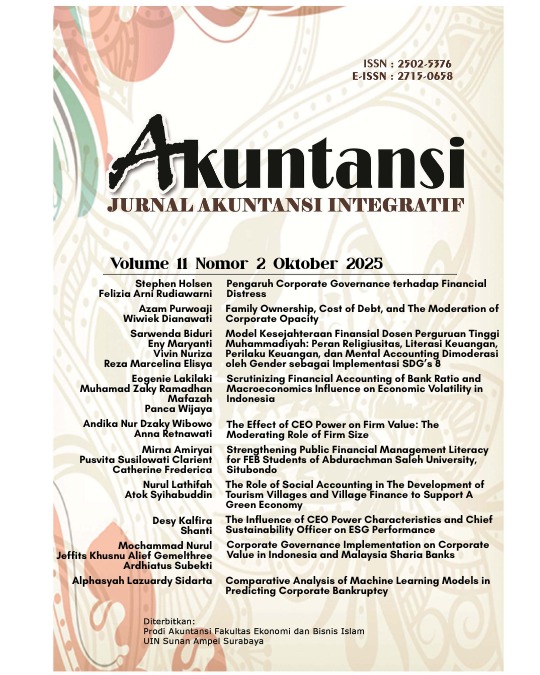
Comparative Analysis of Machine Learning Models in Predicting Corporate Bankruptcy
DOI:
https://doi.org/10.29080/jai.v11i2.2269Keywords:
Bankruptcy Prediction, Financial Ratios, Machine Learning, Springgate Model, Altman Z-ScoreAbstract
This study aims to compare the performance of several machine learning algorithms Logistic Regression, Decision Tree, Random Forest, and XGBoost in predicting corporate bankruptcy based on financial ratio data, and to provide recommendations regarding their practical applicability. The research employed a dummy dataset sourced from Kaggle, which was preprocessed through cleaning, transformation, and encoding. Data were divided into training (80%) and testing (20%) subsets using stratified sampling to address class imbalance. Model performance was evaluated using accuracy, precision, recall, and F1-score. The results reveal that all models demonstrated high predictive capability, with Random Forest achieving the highest accuracy (96.7%), closely followed by XGBoost (≈96%). Logistic Regression (96%) and Decision Tree (95%) also showed strong results. Profitability and leverage indicators, particularly Net Income to Total Assets and debt ratios, emerged as the most influential predictors. The findings underscore that ensemble tree-based methods offer marginally superior performance due to their ability to capture non-linear interactions, while logistic regression remains valuable for interpretability. The use of a dummy dataset limits the direct generalizability of the findings to real-world financial systems. Moreover, reliance on a single train–test split may overestimate model stability. Future research should employ real-world datasets, apply cross-validation techniques, and explore explainability methods such as SHAP or LIME to enhance transparency. This study contributes by providing a comparative evaluation of machine learning models in bankruptcy prediction, highlighting both accuracy and interpretability trade-offs. The results offer practical insights for auditors, investors, and regulators in selecting predictive tools that balance performance, transparency, and decision-making needs.
Downloads
References
Adi, E., Anwar, A., Baig, Z., & Zeadally, S. (2020, May 11). Machine learning and data analytics for the IoT. Springer Nature, 32, 16205-16233. https://doi.org/10.1007/s00521-020-04874-y
Guan, Y., & Zong, Z. (2024). Corporate Financial Risk Identification and Operation Control Analysis for XGBoost Modeling. Applied Mathematics and Nonlinear Science, vol. 9, 1-16. https://www.researchgate.net/publication/382553924_Corporate_Financial_Risk_Identification_and_Operation_Control_Analysis_for_XGBoost_Modeling
Janiesch, C., Zschech, P., & Heinrich, K. (2021, April 8). Machine learning and deep learning. Springer Nature, 31, 685-695. https://doi.org/10.1007/s12525-021-00475-2
Korol, T. (2020, April 28). VILNIUS TECH Journals. Long-term risk class migrations of non-bankrupt and bankrupt enterprises, 21(3), 783-804. https://doi.org/10.3846/jbem.2020.12224
Li, X. (2025). improved Logistic Regression Model Based on Resampling Techniques. Highlights in Science, Engineering and Technology, vol. 136, 28-36. https://www.researchgate.net/publication/390363183_Improved_Logistic_Regression_Model_Based_on_Resampling_Techniques
Mackenzie, A. (2015, June 16). The production of prediction: What does machine learning want? European Journal of Cultural Studies, 18(4-5), 429-445. https://doi.org/10.1177/1367549415577384
Mahesh, B. (2020). Machine Learning Algorithm - A Review. International Journal of Science and Research, vol. 9, 381-386. 10.21275/ART20203995
Mamatzakis, E., Matousek, R., & Vu, A. N. (2015, April 20). What is the impact of bankrupt and restructured loans on Japanese bank efficiency? Journal Of Banking & Finance, 72, 187-202. https://doi.org/10.1016/j.jbankfin.2015.04.010
Moubayed, A., Injadat, M., Nassif, A. B., Lutfiyya, H., & Shami, A. (2018, July 23). E-Learning: Challenges and Research Opportunities Using Machine Learning & Data Analytics. IEEE Xplore, 6, 39117-39138. 10.1109/ACCESS.2018.2851790
Nti, I. K., Quarcoo, J. A., Aning, J., & Fosu, G. K. (2022, January 25). A mini-review of machine learning in big data analytics: Applications, challenges, and prospects. IEEE Xplore, 5(2), 81-97. 10.26599/BDMA.2021.9020028
Qin, S. J., & Chiang, L. H. (2019, July 12). Advances and opportunities in machine learning for process data analytics. Computers & Chemical Engineering, 126, 465-473. https://doi.org/10.1016/j.compchemeng.2019.04.003
Rico, M., & Puig, F. (2021, February 16). Successful turnarounds in bankrupt firms? Assessing retrenchment in the most severe form of crisis. BRQ Business Research Quarterly, 24(2), 114-128. https://doi.org/10.1177/2340944421994117
Roscher, R., Bohn, B., Duarte, M. F., & Garcke, J. (2020, February 24). Explainable Machine Learning for Scientific Insights and Discoveries. IEEE Xplore, 8, 42200 - 42216. 10.1109/ACCESS.2020.2976199
Salman, H. A., Kalakech, A., & Steiti, A. (2024, June 8). Random Forest Algorithm Overview. Babylonian Journal of Machine Learning, 69-79. https://www.researchgate.net/publication/382419308_Random_Forest_Algorithm_Overview
Tanwar, S. (2024). Machine Learning. Computational Science and Its Applications, 1, 30. 9781003347484
Toha, K., & Retnaningsih, S. (2020, March). Legal Policy Granting Status of Fresh Start to the Individual Bankrupt Debtor in Developing the Bankruptcy Law in Indonesia. Academic Journal of Interdisciplinary Studies, 9(2). https://doi.org/10.36941/ajis-2020-0033
Vasudevan, S. K., Dantu, N. V., Pulari, S. R., & Murugesh, T. S. (2023). What is Machine Learning? Taylor & Francis Group, 1, 16. 9781003393122
Wang, L. (2017, July 24). Data Mining, Machine Learning and Big Data Analytics. SciEP, 4(2), 55-61. 10.12691/iteces-4-2-2
Xu, C., & Zhang, H. (2021, January 14). Real earning management in bankrupt firms. Journal of Corporate Accounting & Finance, 32(2), 22-38. https://doi.org/10.1002/jcaf.22483
Downloads
Published
How to Cite
Issue
Section
License
Copyright (c) 2025 Alphasyah Lazuardy Sidarta

This work is licensed under a Creative Commons Attribution-ShareAlike 4.0 International License.