
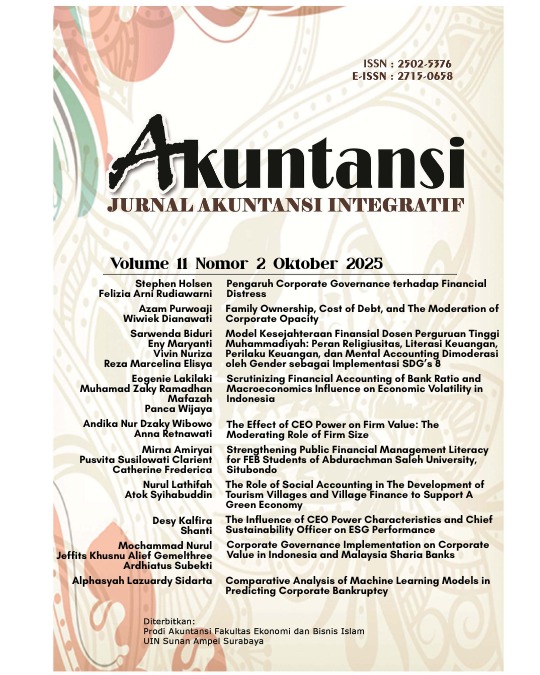
Strengthening Public Financial Management Literacy for FEB Students of Abdurachman Saleh University, Situbondo
DOI:
https://doi.org/10.29080/jai.v11i2.2238Keywords:
Public financial literacy, government financial management, higher education, training evaluation, KirkpatrickAbstract
Strengthening public financial management literacy is an urgent need to produce competent and highly competitive economics graduates, especially in the public sector. This article aims to measure the effectiveness of online seminars in improving students' understanding of the principles of public financial management, including fiscal policy and the preparation of government financial reports, at the Faculty of Economics and Business, Abdurachman Saleh University, Situbondo. The Kirkpatrick evaluation approach was used to assess two aspects: participant reactions and increased knowledge. The results showed that participants responded very positively to the quality of the seminar and the materials presented. In addition, the level of participant understanding of the material was relatively high, as reflected in the post-test results. These findings indicate that interactive seminar-based strategies contribute significantly to strengthening public financial literacy among economics students.
Downloads
References
Fernandes, D., Lynch, J. G., & Netemeyer, R. G. (2014). Financial Literacy, Financial Education, And Downstream Financial Behaviors. Management Science, 60(8), 1861-1883. https://doi.org/10.1287/mnsc.2013.1849
Hastings, J. S., Madrian, B. C., & Skimmyhorn, W. L. (2013). Financial literacy, financial education, and economic outcomes. Annual Review of Economics, 5(1), 347–373. https://doi.org/10.1146/annurev-economics-082312-125807
Huston, S. J. (2010). Measuring Financial Literacy. Journal of Consumer Affairs, 44(2), 296–316. https://doi.org/10.1111/j.1745-6606.2010.01170.x
Kirkpatrick, D. L., & Kirkpatrick, J. D. (2006). Evaluating Training Programs: The Four Levels (3rd ed.). Berrett-Koehler Publishers. https://books.google.co.id/books?id=BJ4QCmvP5rcC
Lusardi, A., & Mitchell, O. S. (2014). The Economic Importance Of Financial Literacy: Theory And Evidence. Journal of Economic Literature, 52(1), 5–44. https://doi.org/10.1257/jel.52.1.5
Mikesell, J. L. (2017). Fiscal Administration: Analysis And Applications For The Public Sector (10th ed.). Cengage Learning.
OECD. (2018). Toolkit for Measuring Financial Literacy and Financial Inclusion. OECD Publishing. https://www.oecd.org/financial/education/2018-INFE-FinLit-Measurement-Toolkit.pdf
Premchand, A. (1999). Public Financial Management: Principles And Practice. International Monetary Fund.
Republik Indonesia. (2003). Undang-Undang No. 17 Tahun 2003 tentang Keuangan Negara. Jakarta: Lembaran Negara Republik Indonesia.
Republik Indonesia. (2004). Undang-Undang No. 33 Tahun 2004 tentang Perimbangan Keuangan antara Pemerintah Pusat dan Daerah. Jakarta: Lembaran Negara Republik Indonesia.
Schick, A. (2007). The Federal Budget: Politics, Policy, and Process. Brookings Institution Press.
Seeling, J., & Maher, C. (2019). Financial Literacy Education In Higher Education Institutions: The Role Of Business Schools. Higher Education Research & Development, 38(6), 1164-1178. https://doi.org/10.1080/07294360.2019.1638345
Transparency International. (2022). Corruption Perceptions Index 2022. Transparency International. https://www.transparency.org/en/cpi/2022
Downloads
Published
How to Cite
Issue
Section
License
Copyright (c) 2025 Mirna Amirya, Pusvita Susilowati, Clarient Catherine Frederica

This work is licensed under a Creative Commons Attribution-ShareAlike 4.0 International License.