
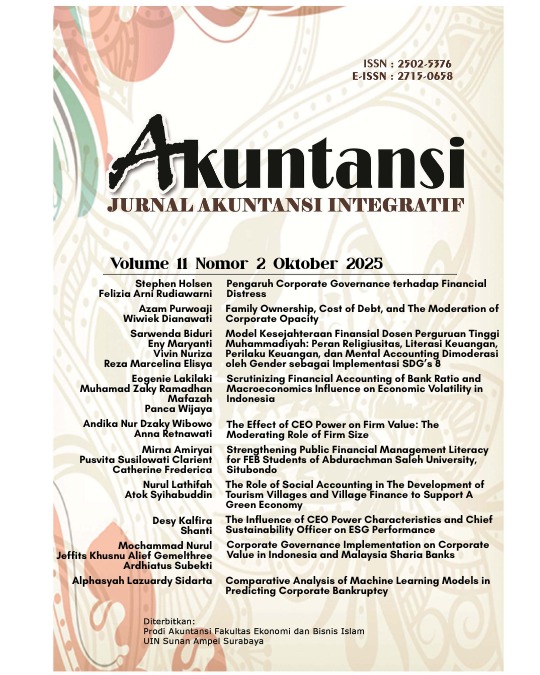
The Influence of CEO Power Characteristics and Chief Sustainability Officer on ESG Performance
DOI:
https://doi.org/10.29080/jai.v11i2.2190Keywords:
CEO education, ownership power, CEO tenure, Chief Sustainability Officer, ESG performanceAbstract
After the Covid-19 pandemic, global companies have faced complex challenges that drive a paradigm shift from a financial focus to social and environmental sustainability. ESG scores serve as an important indicator in assessing corporate sustainability. This study provides an important contribution due to the limited number of studies in Indonesia that examine ESG performance rather than merely ESG disclosure, which allows the results to better reflect the quality of sustainability implementation. This research employs a quantitative approach to analyze the effects of CEO education, ownership power, CEO tenure, and the presence of a CSO on ESG performance, with profitability and firm size as control variables. The research data consist of secondary data from companies listed on the Indonesia Stock Exchange (IDX) for the 2021–2023 period, selected using purposive sampling and analyzed using multiple linear regression with SPSS 30. The findings show that CEO education and ownership power have no significant effect on ESG performance, while CEO tenure and CSO have a significant effect on ESG performance. Companies that establish a CSO demonstrate a proactive approach to addressing ESG issues. This study evaluates the role of CSO which remains underexplored, suggesting that regulators, particularly the OJK, should encourage public companies to position the CSO as a strategic role in presenting ESG scores as part of transparency and accountability in supporting the SDGs.
Downloads
References
Abdullah, Zhu, N., Hashmi, M. A. and Shah, M. H. (2024). CEO power, board features and ESG performance: An extensive novel moderation analysis. Corporate Social Responsibility and Environmental Management, June, 5627–5655. https://doi.org/10.1002/csr.2886
Adhi, R.E and Cahyonowati, N (2023). Pengaruh Enviromental, Social, and Governance Terhadap Nilai Perusahaan Dengan Ukuran Perusahaan Sebagai Variabel Moderasi. http://ejournal-s1.undip.ac.id/index.php/accounting
Al-duais, S. D., Qasem, A., Wan-hussin, W. N., Bamahros, Hasan Mohamad, Thomran, M., and Alquhaif, A. (2021). CEO Characteristics , Family Ownership and Corporate Social Responsibility Reporting : The Case of Saudi Arabia. 1–21.
Al Amosh, H., and Khatib, S. F. . (2022). Ownership structure and environmental, social and governance performance disclosure : the moderating role of the board independence. 2(1), 49–66. https://doi.org/10.1108/JBSED-07-2021-0094
Albaz, M.M, and Alrobai, F (2025). The Impact of CEO and Firm Attributes on ESG Performance: Evidence from an Emerging Market. https://doi.org/10.3390/jrfm18050268
Altuwaijri, B. M., and Kalyanaraman, L. (2020). CEO education-performance relationship: Evidence from Saudi Arabia. Journal of Asian Finance, Economics and Business, 7(8), 259–268. https://doi.org/10.13106/JAFEB.2020.VOL7.NO8.259
Ardi, A., Cahyadi, H., Sarwono, R., Limaho, H., Meilani, Y. F. C. P. and Pramono, R. (2023). The Importance of a Chief Sustainability Officer (CSO) in Multinational and State-Owned Enterprises. Journal of Human, Earth, and Future, 4(3), 303–315. https://doi.org/10.28991/HEF-2023-04-03-04
Arofah, S. N., and Khomsiyah. (2023). Pengaruh Good Corporate Governance dan Environmental Social Governance terhadap Nilai Perusahaan dengan Kinerja Keuangan Sebagai Moderasi. Jurnal Informatika Ekonomi Bisnis, 5, 125–133.https://doi.org/10.37034/infeb.v5i1.208
Baraibar-Diez, E. and Odriozola, M. D. (2019). CSR committees and their effect on ESG performance in UK, France, Germany, and Spain. Sustainability (Switzerland), 11(18). https://doi.org/10.3390/su11185077
Dillak, Vaya Juliana, D., and Hapsari, T. A. (2024). CEO POWER , GENDER DIVERSITY AND ESG PERFORMANCE : EVIDENCE FROM FINANCIAL COMPANIES IN ASEAN-5. Jurnal Riset Akuntansi Kontemporer Volume 16, No. 2, October 2024.
Ebele, N. E., Bae, S. M. and Kim, J. D. (2023). The Impact of Chief Sustainability Officers on Environmental Performance of Korean Listed Companies: The Mediating Role of Corporate Sustainability Practices. Sustainability, 15(20), 14819. https://doi.org/10.3390/su152014819
Freeman, R. E. (1984). Strategic Management: A Stakeholder Approach (Pitman).
Freeman, R. E., and Dmytriyev, S. (2023). R. Edward Freeman’s selected works on stakeholder theory and business ethics.
Fadilah, S. N. and Venusita, L. (2024). CEO Power dalam Kaitannya dengan Nilai Perusahaan. 12(3), 226–236. https://doi.org/10.26740/akunesa
Farizki, D. and Harto, P (2025). Pengaruh Board Characteristics Terhadap ESG Performance Dengan Family Ownership Sebagai Variabel Moderasi. http://ejournal-s1.undip.ac.id/index.php/accounting.
Fitriasari. (2023). Dampak Tata Kelola Perusahaan yang Berkelanjutan terhadap Pengungkapan Lingkungan Perusahaan. 6(1), 70–81.
Garcia-Blandon, J., Argiles-Bosch, J. M., and Ravenda, D. (2019). Exploring the Relationship Between Ceo. Journal of Business Economics and Management, 20(6), 1064–1082.
Ghardallou, W. (2022). Corporate Sustainability and Firm Performance: The Moderating Role of CEO Education and Tenure. Sustainability (Switzerland), 14(6). https://doi.org/10.3390/su14063513
Hambrick, D.C. and Mason, P. A. (1984). “Upper echelons: the organization as a reflection of its top managers.” Academy of Management Review.
Haneul, Ahmad, G. N. and Siregar, M. E. (2023). Pengaruh CEO Characteristics terhadap Firm Performance pada Masa Pandemi COVID-19. AT-TAWASSUTH: Jurnal Ekonomi Islam, VIII(I), 1–19.
Herlambang, I. R. (2024). Board Characteristics and ESG Performance pada Perusahaan Amerika Serikat selama Pandemi Covid-19 Board Characteristics and ESG Performance of United States Corporations during Covid-19 Pandemic. 9(2), 241–254. https://doi.org/10.20473/baki.vxix.xxxxx
Hu, X., Zhu, W., Zhang, C., Zhang, T. and Zhang, C. (2023). Research on the Rules of Esg Performance and Value Creation Based on Rough Sets. Journal of Business Economics and Management, 24(6), 996–1018. https://doi.org/10.3846/jbem.2023.20631
Jensen, M. C., and Meckling, W. H. (1976). Theory of the Firm : Managerial Behavior , Agency Costs and Ownership Structure. Journal of Financial Economics, 3(4), 305–360. Https://Doi.Org/Https://Doi. Org/10.1016/0304-405X(76)90026-X
Kaur, R. and Singh, B. (2019). Do CEO characteristics explain firm performance in India? Journal of Strategy and Management, 12(3), 409–426. https://doi.org/10.1108/JSMA-02-2019-0027
Khan, T. M., Bai, G., Fareed, Z., Quresh, S., Khalid, Z., and Khan, W. A. (2021). CEO Tenure, CEO Compensation, Corporate Social and Environmental Performance in China: The Moderating Role of Coastal and Non-coastal Areas. Frontiers in Psychology, 11(January). https://doi.org/10.3389/fpsyg.2020.574062
Kutzschbach, J., Peetz, I., Tanikulova, P., and Willers, K. (2020). How CEO ’ s education impacts CSR performance – An empirical analysis of publicly listed companies in Germany. September.
Lavin, J. F. and Montecinos-Pearce, A. A. (2021). Esg disclosure in an emerging market: An empirical analysis of the influence of board characteristics and ownership structure. Sustainability (Switzerland), 13(19), 1–25. https://doi.org/10.3390/su131910498
Lee, A. X., and Hooy, C. W. (2024). CEO Power and ESG Performance: The Mediating Role of Managerial Risk-Taking. Institutions and Economies, 16(2), 57–82. https://doi.orgzhu.22452/IJIE.vol16no2.3
Li, W., Zhu, J. and Liu, C. (2024). Environmental , social , and governance performance , financing constraints , and corporate investment efficiency : Empirical evidence from China. Heliyon, 10(22), e40401. https://doi.org/10.1016/j.heliyon.2024.e40401
Menicucci, E. and Paolucci, G. (2022). Board Diversity and ESG Performance : Evidence from the Italian Banking Sector. 1–19.
Oktafiyani, H., Puspawati, D., and Permatasari, W. . (2024). Faktor-Faktor Yang Mempengaruhi Pengungkapan ESG Pada Perusahaan Di Indonesia. YUME: Journal of Management, 7(2), 92–106. https://journal.stieamkop.ac.id/index.php/yume/article/view/6595%0A
Omura, A., Roca, E. and Nakai, M. (2021). Does responsible investing pay during economic downturns : Evidence from the COVID-19 pandemic. Finance Research Letters, 42(December 2020), 101914. https://doi.org/10.1016/j.frl.2020.101914
Pradinata, I. A., Handoko, J. and Mokoginta, D. D. (2024). Jurnal Akuntansi Keuangan dan Bisnis Politeknik Caltex Riau Analisis Environment , Social , Governance dan Struktur Kepemilikan Terhadap Nilai Perusahaan Dengan Pemoderasi Kekuatan CEO. 17(November), 65–73.
Ren and Cheng. (2024). The impact of ESG performance on corporate risk-taking: empirical evidence from China. Journal of Sustainable Finance and Investment, 1–22. https://doi.org/10.1080/20430795.2024.2366179
Roestanto, A., Vivianita, A., and Nurkomalasari, N. (2022). INDUSTRI , DAN STRUKTUR KEPEMILIKAN TERHADAP ENVIRONMENTAL , SOCIAL , AND GOVERNANCE ( ESG ) DISCLOSURE ( STUDI EMPIRIS PERUSAHAAN DI INDONESIA YANG TERDAFTAR DI IDX 2017-2020 ) perusahaan wajib untuk mempertanggungjawabkan aktivitas operasinya yang berda. 08(1), 1–18.
Rohman, H. A. N., Ainiyah, N. and Ilmidaviq, M. B. (2024). Pengaruh Environmental , Social , and Governance ( ESG ) terhadap Financial Performance : Peran Struktur Kepemilikan sebagai Variabel Pemoderasi. 1(3).
Sang, S., Yan, A. and Ahmad, M. (2024). CEO Experience and Enterprise Environment, Social and Governance Performance: Evidence from China. Sustainability (Switzerland), 16(11), 1–20. https://doi.org/10.3390/su16114403
Sekarlangit, L. D. and Wardhani, R. (2021). The effect of the characteristics and activities of the board of directors on sustainable development goal (Sdg) disclosures: Empirical evidence from southeast asia. Sustainability (Switzerland), 13(14). https://doi.org/10.3390/su13148007
Setiani, E. P. and Novitasari, B. T. (2024). Exploring the Impact of Board Attributes on ESG Scores of Indonesian Companies. Nominal Barometer Riset Akuntansi Dan Manajemen, 13(1), 131–143. https://doi.org/10.21831/nominal.v13i1.72362
Tambunan, R. and Wahyuliza, S. (2024). PENGARUH KEPEMILIKAN INSTITUSIONAL, KEPEMILIKAN MANAJERIAL, KEPEMILIKAN ASING TERHADAP PENGUNGKAPAN ESG (Studi Empiris Pada Perusahaan Yang Terdaftar di BEI Tahun 2020 – 2022). 13(2), 1–11.
Triyani, A. and Setyahuni, S. W. (2020). Pengaruh Karakteristik Ceo Terhadap Pengungkapan Informasi Environmental, Social, and Governance (Esg). Jurnal Ekonomi Dan Bisnis, 21(2), 72. https://doi.org/10.30659/ekobis.21.2.72-83
Tu, K. and Guo, Y. (2024). How higher education affects corporate ESG performance: Empirical evidence from Chinese listed companies. Finance Research Letters, 68(July), 105812. https://doi.org/10.1016/j.frl.2024.105812
Velte, P. (2020). Institutional ownership, environmental, social, and governance performance and disclosure – A review on empirical quantitative research. Problems and Perspectives in Management, 18(3), 282–306. https://doi.org/10.21511/ppm.18(3).2020.24
Villalonga, B., Tufano, P. and Wang Morningstar, B. (2022). Corporate Ownership and ESG Performance.
Wan, Y., Hong, Z., Liu, Wenqing, D., and Cui, J. (2023). Executives’ education: A catalyst for enhanced ESG disclosure. Finance Research Letters, 58(PB), 104429. https://doi.org/10.1016/j.frl.2023.104429
Wang, Q., Pei, X. and Liang, H. (2022). Founder CEO, CEO Characteristics, and Firm Innovation Efficiency: An Empirical Study of China’s GEM-Listed Companies. Sustainability (Switzerland), 14(14). https://doi.org/10.3390/su14148250
Wibowo, A. (2023). Tata Kelola Entitas Perusahaan. Yayasan Prima Agus Teknik.
Xu, Y and Zhu, N. (2024). The Effect of Environmental, Social, and Governance ( ESG ) Performance on Corporate Financial Performance in China : Based on the Perspective of Innovation and Financial Constraints. Sustainability 2024, 16, 3329. Https://Doi.Org/10.3390/Su16083329.
Yan, Y. (2000). 3 Theories Relevant to Ownership and Control. International Joint Ventures in China, 39–40.
Yuan, W. (2024). What Are the Key Influencing Factors of ESG? Empirical Research Based on Chinese Listed Companies. Advances in Economics, Management and Political Sciences, 66(1), 38–46. https://doi.org/10.54254/2754-1169/66/20241205
Zahroh, B. M. and Hersugondo. (2021). PENGARUH KINERJA LINGKUNGAN, SOSIAL, DAN TATA KELOLA TERHADAP KINERJA KEUANGAN DENGAN KEKUATAN CEO SEBAGAI VARIABEL MODERASI (Studi Pada Perusahaan Manufaktur yang Terdaftar di Bursa Efek Indonesia Periode 2015-2019). 10, 1–15.
Zhou, B., Dutta, Shantanu, D., and Zhu, P. (2020). CEO tenure and mergers and acquisitions. Finance Research Letters, 34(February 2019), 101277. https://doi.org/10.1016/j.frl.2019.08.025
CNBC. (2023). Miris! Pelaku Usaha yang Paham Praktik ESG Cuma 35%. https://www.cnbcindonesia.com/news/20231211143918-4-496192/miris-pelaku-usaha-yang-paham-praktik-esg-cuma-35
IAI. (2023). Akuntansi Keuangan berdasarkan SAK berbasis IFRS. Jakarta: Ikatan Akuntansi Indonesia.
Downloads
Published
How to Cite
Issue
Section
License
Copyright (c) 2025 Desy Kalfira, Shanti

This work is licensed under a Creative Commons Attribution-ShareAlike 4.0 International License.