
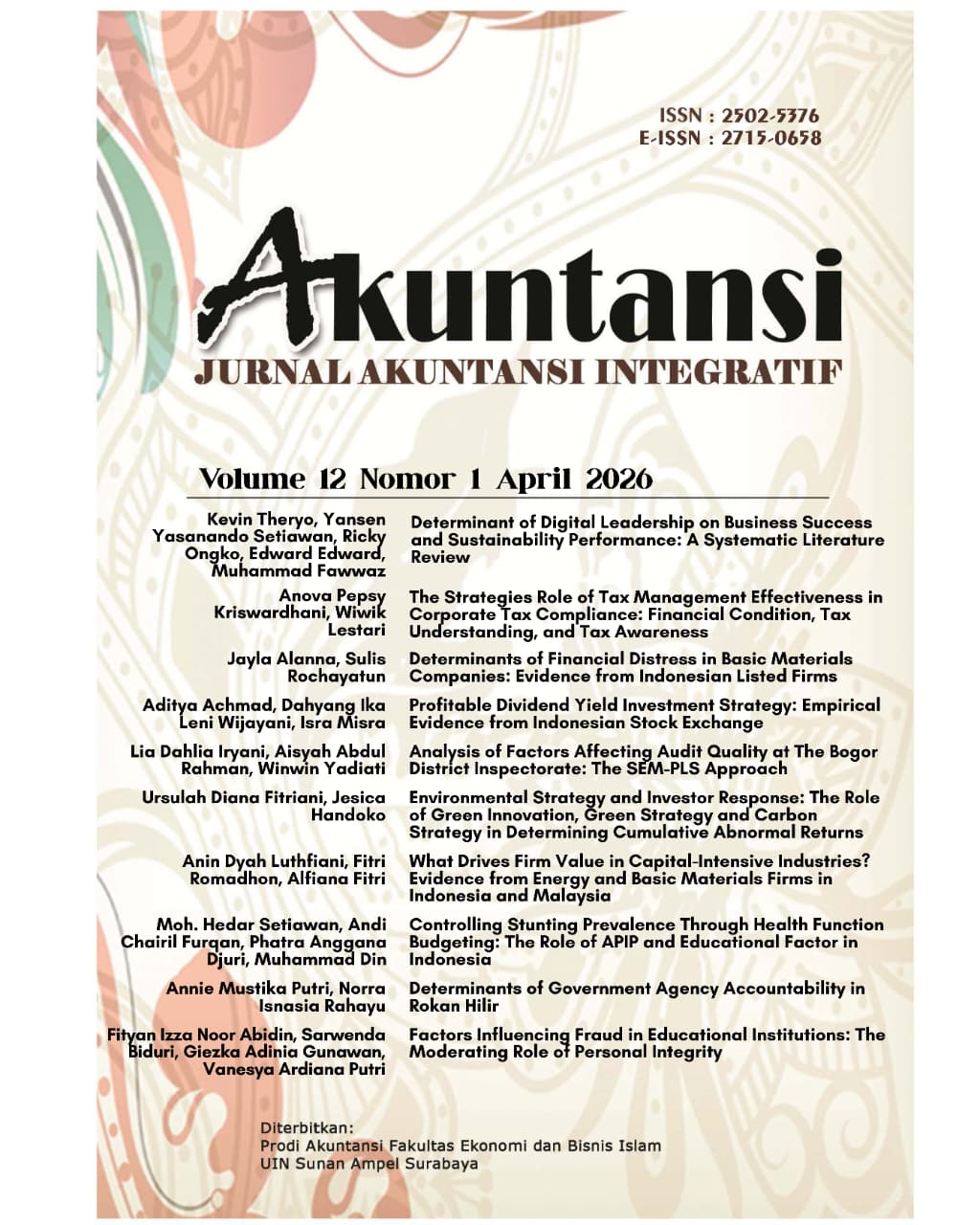
Profitable Dividend Yield Investment Strategy: Empirical Evidence from Indonesian Stock Exchange
DOI:
https://doi.org/10.29080/jai.v12i1.2176Keywords:
Profitable Dividend Yield, Gross Profit Assets, Dividend Yield, Value Investing, Fundamental AnalysisAbstract
Purpose: This study seeks to address the challenges of the dividend trap phenomenon and irrational investor behavior amid extreme stock price fluctuations. Stock price volatility often triggers irrational investor behavior and asymmetric information, rendering traditional index-based investing insufficient for risk mitigation.
Methodology/approach: A quantitative approach was used in analyzing the data. Portfolios were formed through quintile classification based on two main variables: Gross Profitability to Assets (GPA) and Dividend Yield (DY). Portfolio performance was then evaluated using risk-adjusted return (Sharpe Ratio) and geometric mean return metrics to compare the performance of the PDY strategy against the benchmark Jakarta Composite Index (JCI) and fixed-income assets.
Findings: The results show that the best quintile portfolio (G5D5) consistently provides superior returns compared to the market and fixed-income assets. This finding provides empirical confirmation of the application of signaling theory and bird-in-the-hand theory in emerging markets, where dividend payments accompanied by strong profitability serve as credible signals of a company's prospects.
Practical Implication: This study provides guidance for investors and investment managers in developing a defensive portfolio strategy that is still able to provide capital appreciation and stable dividend income, especially in an inefficient market.
Originality: The novelty of the study lies in the integration of gross profitability and dividend yield criteria with a specific focus on the Islamic stock index (ISSI), an area that is still rarely explored in depth in the asset pricing literature in Indonesia.
Downloads
References
Asness, C. S., Frazzini, A., & Pedersen, L. H. (2019). Quality Minus Junk. Review of Accounting studies, 24 (1), 34-112. https://doi.org/10.1007/s11142-018-9470-2
Baker, M., Bradley, B., & Wurgler, J. (2011). Benchmarks as limits to arbitrage: Understanding the low-volatility anomaly. Financial Analysts Journal, 67 (1), 40–54. https://doi.org/10.2469/faj.v67.n1.4
Ball, R., Gerakos, J., Linnainmaa, J. T., & Nikolaev, V. V. (2015). Deflating profitability. Journal of Financial Economics, 117(2), 225-248. https://doi.org/10.1016/j.jfineco.2015.02.004
BEI. (2025). High Dividend Index 20 Fact Sheet. High Dividend Index Fact Sheet 20. https://www.idx.co.id/id/data-pasar/report-statistik/fact-sheet-index/
Benjamin Graham, D.L.D. (1934). Security analysis: Principles and techniques. McGraw-Hill.
Bermejo, R., Figuerola-Ferretti, I., Hevia, T., & Santos, A. (2021). Investasi faktor: Metodologi pemilihan saham untuk pasar ekuitas Eropa. Heliyon, 7 (10). https://doi.org/10.1016/j.heliyon.2021.e08168.
Bhootra, A. (2018). Gross profitability and momentum. Managerial Finance, 44(8), 992-1011. https://doi.org/10.1108/MF-11-2017-0444
Brooks, J., Palhares, D., & Richardson, S. A. (2018). Style investing in fixed income. Journal of Portfolio Management, Forthcoming. https://papers.ssrn.com/sol3/papers.cfm?abstract_id=3130245
Daniel, K., & Moskowitz, T. J. (2016). Momentum crashes. Journal of Financial economics, 122(2), 221-247. https://doi.org/10.1016/j.jfineco.2015.12.002
Eliza, E. (2013). The Relationship between the Intrinsic Value of a Share and the Market Price of the Share. Journal of Economics, Esa Unggul University, 4 (1), 17900. https://doi.org/10.47007/jeko.v4i1.1024
Fama, E.F., & French, K.R. (2006a). The cross‐section of expected stock returns. The Journal of Finance , 47 (2), 427–465. https://doi.org/10.1111/j.1540-6261.1992.tb04398.x
Fama, E.F., & French, K.R. (2006b). The value premium and the CAPM. The Journal of Finance , 61 (5), 2163–2185. https://doi.org/10.1111/j.1540-6261.2006.01054.x
Fama, E.F., & French, K.R. (2012). Size, value, and momentum in international stock returns. Journal of Financial Economics , 105 (3), 457–472. https://doi.org/10.1016/j.jfineco.2012.05.011
FERDIANA, W. (2023). Assessing The Effectiveness of The Dividend Yield Based Investment Strategy: A Case Study of The Dogs of The Dow Strategy in The Indonesia Stock Exchange (IDX) LQ45 Index from 2012 to 2022. https://digilib.itb.ac.id/assets/files/2023/MjAyM19UU19QUF9XZW1waHkgRmVyZGlhbmFfMjkxMjE1NDJfRml4IEFraGlyLnBkZg.pdf
Fong, W. M. (2016). A Profitable Dividend Yield Strategy for Retirement Portfolios. The Journal of Retirement , 3 (3), 51–61. https://doi.org/10.3905/jor.2016.3.3.051
Fong, W. M. (2018). “Safe” stocks. Journal of Asset Management, 19, 93–98. https://doi.org/10.1057/s41260-017-0050-y
Fong, W.M., & Koh, T. (2015). Strategic asset allocation with low-risk stocks: a bootstrap analysis. Journal of Investment Management , 13 (2), 39–58. https://joim.com/issue/2015q2/
Fuller, K. P., & Goldstein, M. A. (2011). Do dividends matter more in declining markets?. Journal of Corporate Finance , 17 (3), 457–473. https://doi.org/10.1016/j.jcorpfin.2011.01.001
Ge, W. (2019). Utilizing Low-Volatility Assets to Mitigate Sequence Risk in Retirement Investing. The Journal of Investing . https://doi.org/10.3905/joi.2019.1.087
Jannah, M., & Imansyah, F. (2019). Analisis Strategi Investasi Magic Formula pada Bursa Efek Indonesia. Jurnal Riset Akuntansi Dan Keuangan Vol, 7(2). https://doi.org/10.17509/jrak.v7i2.17698
Kothe, J., Lohre, H., & Rother, C. (2021). Faktor suku bunga dan alokasi aset global. Jurnal Pendapatan Tetap , 30 (3), 6-25. DOI:10.3905/jfi.2020.1.098.
KSEI. (2023). Indonesian Capital Market Statistics . https://www.ksei.co.id/files/Statistik_Pu blik_-_Februari_2023_v3.pdf
Novy-Marx, R. (2013). The other side of value: The gross profitability premium. Journal of Financial Economics , 108 (1), 1–28. https://doi.org/10.1016/j.jfineco.2013.01.003
Novy-Marx, R. (2015). Fundamentally, momentum is fundamental momentum (No. w20984). National Bureau of Economic Research. https://doi.org/10.3386/w20984
Rakim, AA (2018). The Role of Market Timing Equity, and Corporate Strategy in Determining Firms Capital Structure. JSHP (Journal of Social Humanities and Education), 2 (2), 143. https://doi.org/10.32487/jshp.v2i2.480
Rakim, AA, & Wijaya, DIL (2025). Strategi Investasi Formula Ajaib: Bukti Empiris dari Bursa Efek Indonesia. JSHP: Jurnal Sosial Humaniora dan Pendidikan, 9 (2), 190-199. https://doi.org/10.32487/jshp.v9i2.2556
Rakim, AA, Iqbal, M., & Misra, I. (2022). Analysis of investment strategy in Indonesian consumer goods industry: Benjamin Graham's approach. Diponegoro International Journal of Business, 5 (1), 57–69. https://doi.org/10.14710/dijb.5.1.2022.57-69
Retha, HMA, & Budiarti, R. (2023). Analysis of Return Method Dogs Of The Dow with T-Test on IDXHIDIV20. ABEC Indonesia, 198–206. https://garuda.kemdiktisaintek.go.id/documents/detail/3441307
Samudra, S., Farid, ES, Risendy, R., Andriani, N., Utami, AP, & Ali, MH (2024). Dividend Investing Strategy: A Case Study on The Indonesian Stock Exchange. Indonesian Journal of Accounting and Business (JABISI) , 5 (2), 152–158. https://doi.org/10.55122/jabisi.v5i2.1527
Sekaran, U., & Bougie, R. (2017). Research Methods for Business: A Skill Development Approach 6th Edition Book 2 .
Sorokin, I. A. (2020). The evaluation of the effectiveness of high-dividend strategies in world markets. Vestnik Moskovskogo universiteta. Seriia 6. Economics, 3, 106–126. https://doi.org/10.38050/01300105202035
SULISTYANA, H. (2023). Strategic Portfolio Optimization. https://digilib.itb.ac.id/assets/files/2024/MjAyNF9UU19QUF9IYXJpIFN1bGlzdHlhbmEgMjkxMjE1MjVfRnVsbCBUZXh0LnBkZg.pdf
Syahfrina, A. (nd). Analysis of Stock Portfolio Performance of Dogs of the Dow Strategy with Jensen's alpha, Sharpe, Treynor, and Sortino Methods for the Period 2009-2019 . Faculty of Economics and Business, UIN Syarif Hidayatullah Jakarta. https://www.repository.uinjkt.ac.id/dspace/bitstream/123456789/57563/
Tandelilin, E. (2010). Portfolio and Investment: Theory and Application . Kanisius.
Taruna, MS, Abdi, MN, Priatiningsih, D., & Neha, MF (nd). Formulation of the Dividend Trap Score: A Study on IDX NON-CYC Food and Beverage Sector Firms. https://www.researchgate.net/profile/Mohammad-Sigit-Taruna/publication/391850570_Formulation_of_the_Dividend_Trap_Score_A_Study_on_IDX_NON-CYC_Food_and_Beverage_Sector_Firms/links/6829dd80026fee1034f8e9c8/Formulation-of-the-Dividend-Trap-Score-A-Study-on-IDX-NON-CYC-Food-and-Beverage-Sector-Firms.pdf
Traut, J. (2023). What we know about the low-risk anomaly: a literature review. Financial markets and portfolio management, 37(3), 297-324. https://doi.org/10.1007/s11408-023-00427-0
Wijayanti, NW, Rakim, AA, & Ghozi, S. (2020). Stock Valuation Using Discounted Cash Flow Method in Financing Institution Sub-Sector in Indonesia. Proceedings of SNITT Poltekba , 4 , 163–170. https://jurnal.poltekba.ac.id/index.php/prosiding/article/view/1015
Yuda, GC, & Prasetyanta, A. (2019). Portfolio Formation Based on Dividend Payout Using The Foolish Four on the Lq45 Index for the 2012-2016 Period. Equilibrium , 13 (1), 87–94. https://doi.org/10.61179/EJBA
Downloads
Published
How to Cite
Issue
Section
License
Copyright (c) 2026 Aditya Achmad Rakim, Dahyang Eka Leni Wijayani, Isra Misra

This work is licensed under a Creative Commons Attribution-ShareAlike 4.0 International License.