
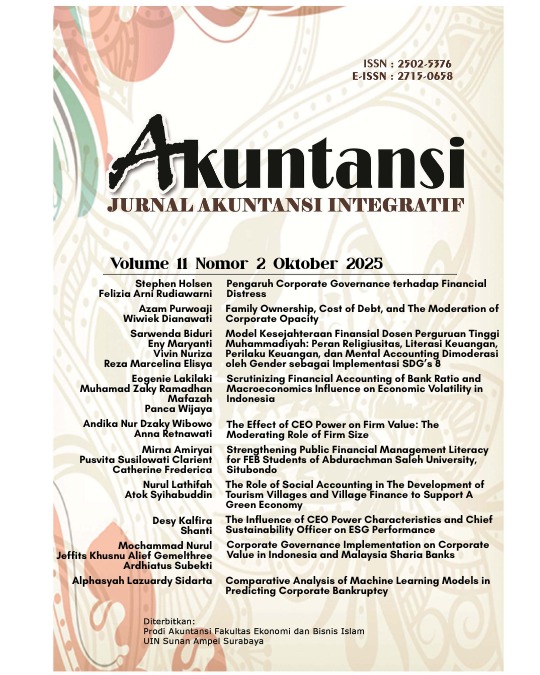
Corporate Governance Implementation on Corporate Value in Indonesia and Malaysia Sharia Banks
DOI:
https://doi.org/10.29080/jai.v11i2.2163Keywords:
ISR, Corporate Governance, Social Disclosure, Sharia BankAbstract
Islamic banking has experienced rapid growth in Southeast Asia. Islamic Social Reporting (ISR) integrates Islamic values to demonstrate banks' compliance with religious standards. This study analyzes ISR disclosure's mediating role between corporate governance mechanisms and firm value in Islamic banking. Using panel data from 2014-2020 from 12 Indonesian and 15 Malaysian Islamic banks (168 company-year observations), we employ ordinary regression analysis to analyze how board size, board independence, Sharia supervisory board size, audit committee size, and audit committee meeting frequency affect corporate value through ISR disclosure. Board size and independence significantly affect firm value, with ISR as partial mediator, showing these mechanisms enhance value through stakeholder trust. The Sharia supervisory board size impacts both ISR disclosure and firm value, with ISR partially mediating, indicating effective oversight enhances value through direct supervision and ethical reporting. The audit committee size and meeting frequency increase ISR disclosure, with ISR fully mediating their relationship with firm value, suggesting audit committees influence value through improved social reporting rather than direct market effects. These results show governance mechanisms operate differently requiring tailored strategies to optimize social responsibility and financial performance.
Downloads
References
Agyemang-Mintah, P., & Schadewitz, H. (2018). Audit committee adoption and firm value: evidence from UK financial institutions. International Journal of Accounting and Information Management, 26(1), 205–226. https://doi.org/10.1108/IJAIM-04-2017-0048
Allegrini, M., & Greco, G. (2013). Corporate boards, audit committees and voluntary disclosure: Evidence from Italian Listed Companies. Journal of Management and Governance, 17(1), 187–216. https://doi.org/10.1007/s10997-011-9168-3
Aminu Isa, M., & Muhammad, S. (2014). The Impact of Board Characteristics on Corporate Social Responsibility Disclosure: Evidence from Nigerian Food Product Firms. International Journal of Management Science and Business Administration, 1(12), 34–45. https://doi.org/10.18775/ijmsba.1849-5664-5419.2014.112.1004
An, Y. (2023). DOES QUALITY OF AUDIT COMMITTEE ENHANCE AUDIT QUALITY? | A QUALIDADE DO COMITÊ DE AUDITORIA MELHORA A QUALIDADE DA AUDITORIA? | LA CALIDAD DEL COMITÉ DE AUDITORÍA MEJORA LA CALIDAD DE LA AUDITORÍA? International Journal of Professional Business Review, 8(2). https://doi.org/10.26668/businessreview/2023.v8i2.1385
Annex 5. (2009). In OECD Benchmark Definition of Foreign Direct Investment 2008 (pp. 174–179). OECD. https://doi.org/10.1787/9789264045743-15-en
Anshori, A. G. (2018). Perbankan Syariah di Indonesia (1st ed.). UGM PRESS.
Appuhami, R., & Tashakor, S. (2017). The Impact of Audit Committee Characteristics on CSR Disclosure: An Analysis of Australian Firms. Australian Accounting Review, 27(4), 400–420. https://doi.org/10.1111/auar.12170
Apriliani Astuti, M., Dewi Y Rozali, R., & Cakhyaneu, A. (2019). Prevention of Fraud in Sharia Banking in Indonesia through Implementation of Sharia Corporate Governance. KnE Social Sciences, 3(13), 183. https://doi.org/10.18502/kss.v3i13.4205
Barako, D. G., & Brown, A. M. (2008). Corporate social reporting and board representation: Evidence from the Kenyan banking sector. Journal of Management and Governance, 12(4), 309–324. https://doi.org/10.1007/s10997-008-9053-x
Baron, R. M., & Kenny, D. A. (1986). The Moderator-Mediator Variable Distinction in Social Psychological Research: Conceptual, Strategic, and Statistical Considerations. European Journal of Women’s Studies, 51(6), 1173–1182. https://doi.org/10.1177/1350506818764762
Bédard, J., Chtourou, S. M., & Courteau, L. (2004). The effect of audit committee expertise, independence, and activity on aggressive earnings management. Auditing, 23(2), 13–35. https://doi.org/10.2308/aud.2004.23.2.13
Bédard, J., Coulombe, D., & Courteau, L. (2008). Audit committee, underpricing of IPOs, and accuracy of management earnings forecasts. Corporate Governance: An International Review, 16(6), 519–535. https://doi.org/10.1111/j.1467-8683.2008.00708.x
Brigham, E. F., & Phillip R. Daves. (2007). Intermediate Financial Management (9th ed.). Thomson Corporation.
Buniamin, S., Alrazi, B., Johari, N. H., & Abd Rahman, N. R. (2011). Corporate governance practices and environmental reporting of companies in Malaysia: Finding possibilities of double thumbs up. Jurnal Pengurusan, 32, 55–71. https://doi.org/10.17576/pengurusan-2011-32-06
Dienes, D., & Velte, P. (2016). The impact of supervisory board composition on CSR reporting. Evidence from the German two-tier system. Sustainability (Switzerland), 8(1), 1–20. https://doi.org/10.3390/su8010063
Engel, L., Bryan, S., Noonan, V. K., & Whitehurst, D. G. T. (2018). Using path analysis to investigate the relationships between standardized instruments that measure health-related quality of life, capability wellbeing and subjective wellbeing: An application in the context of spinal cord injury. Social Science and Medicine, 213, 154–164. https://doi.org/10.1016/j.socscimed.2018.07.041
Farook, S., Kabir Hassan, M., & Lanis, R. (2011). Determinants of corporate social responsibility disclosure: the case of Islamic banks. Journal of Islamic Accounting and Business Research, 2(2), 114–141. https://doi.org/10.1108/17590811111170539
Fernández-Gago, R., Cabeza-García, L., & Nieto, M. (2018). Independent directors’ background and CSR disclosure. Corporate Social Responsibility and Environmental Management, 25(5), 991–1001. https://doi.org/10.1002/csr.1515
Frias-Aceituno, J. V, Rodriguez-Ariza, L., & Garcia-Sanchez, I. M. (2013). The role of the board in the dissemination of integrated corporate social reporting. Corporate Social Responsibility and Environmental Management, 20(4), 219–233. https://doi.org/10.1002/csr.1294
Fuente, J. A., García-Sánchez, I. M., & Lozano, M. B. (2017). The role of the board of directors in the adoption of GRI guidelines for the disclosure of CSR information. Journal of Cleaner Production, 141, 737–750. https://doi.org/10.1016/j.jclepro.2016.09.155
Ghozali, M., Azmi, M. U., & Nugroho, W. (2019). Perkembangan Bank Syariah Di Asia Tenggara: Sebuah Kajian Historis. Falah: Jurnal Ekonomi Syariah, 4(1), 44. https://doi.org/10.22219/jes.v4i1.8700
Greco, G. (2011). Determinants of board and audit committee meeting frequency. Managerial Auditing Journal, 26(3), 208–229. https://doi.org/10.1108/02686901111113172
Hafsi, T., & Turgut, G. (2013). Boardroom Diversity and its Effect on Social Performance: Conceptualization and Empirical Evidence. Journal of Business Ethics, 112(3), 463–479. https://doi.org/10.1007/s10551-012-1272-z
Haji, A. A. (2013). Corporate social responsibility disclosures over time: Evidence from Malaysia. Managerial Auditing Journal, 28(7), 647–676. https://doi.org/10.1108/MAJ-07-2012-0729
Haniffa, R. (2002). Social Responsibility Disclosure: An Islamic Perspective. Indonesian Management & Accounting Research, 1(2).
Haniffa, R. M., & Cooke, T. E. (2005). The impact of culture and governance on corporate social reporting. Journal of Accounting and Public Policy, 24(5), 391–430. https://doi.org/10.1016/j.jaccpubpol.2005.06.001
Hariati, I., & Rihatiningtyas, Y. W. (2015). Pengaruh Tata Kelola Perusahaan dan Kinerja Lingkungan Terhadap Nilai Perusahaan. Simposium Nasional Akuntansi XVIII, 1–16.
Hassan, A. F. S., & Haridan, N. M. (2019). Shariah Auditing and Shariah Compliance Assurance in Malaysian Islamic Banks. Global Journal Al Thaqafah, 61–72.
Hussain, M. A., Hassan, R., & Azhar, A. (2016). The procedures of appointment and cessation of the Shariah committee member of the islamic banks and Takaful companies in Malaysia: Legal analysis. International Journal of Economics and Financial Issues, 6(7Special I), 266–270.
Hussain, M. A., Noor, F. M., Nor, M. Z. M., & Azhar, A. (2022). Strengthening the Relationship between Shariah Committee and Board of Directors of Islamic Banks. Bild Law Journal, 7(1), 60–64.
Ibrahim, M. (2020). ISLAMIC BANKING AND BANK PERFORMANCE IN MALAYSIA: AN EMPIRICAL ANALYSIS. Journal of Islamic Monetary Economics and Finance, 6(3). https://doi.org/10.21098/jimf.v6i3.1197
Jamaludin, A. F., & Razali, M. N. (2024). ASSESSING THE IMPLEMENTATION OF ENVIRONMENTAL, SOCIAL, AND GOVERNANCE (ESG) BY SOUTHEAST ASIAN LISTED PROPERTY COMPANIES. Pacific Rim Property Research Journal, 29(2), 30–65.
Jensen, M. C. (1999). Agency Cost Of Free Cash Flow, Corporate Finance, and Takeovers. SSRN Electronic Journal. https://doi.org/10.2139/ssrn.99580
Jizi, M. I., Salama, A., Dixon, R., & Stratling, R. (2014a). Corporate Governance and Corporate Social Responsibility Disclosure: Evidence from the US Banking Sector. Journal of Business Ethics, 125(4), 601–615. https://doi.org/10.1007/s10551-013-1929-2
Jizi, M. I., Salama, A., Dixon, R., & Stratling, R. (2014b). Corporate Governance and Corporate Social Responsibility Disclosure: Evidence from the US Banking Sector. Journal of Business Ethics, 125(4), 601–615. https://doi.org/10.1007/s10551-013-1929-2
Jo, H., & Harjoto, M. A. (2011). Corporate Governance and Firm Value: The Impact of Corporate Social Responsibility. Journal of Business Ethics, 103(3), 351–383. https://doi.org/10.1007/s10551-011-0869-y
Karim, R., Roshid, M. M., Dhar, B. K., Nahiduzzaman, M., & Kuri, B. C. (2024). Audit Committee Characteristics and Sustainable Firms’ Performance: Evidence From the Financial Sector in Bangladesh. Business Strategy and Development, 7(4). https://doi.org/10.1002/bsd2.70059
Kaymak, T., & Bektas, E. (2017). Corporate Social Responsibility and Governance: Information Disclosure in Multinational Corporations. Corporate Social Responsibility and Environmental Management, 24(6), 555–569. https://doi.org/10.1002/csr.1428
Kelton, A. S., & Yang, Y. wen. (2008). The impact of corporate governance on Internet financial reporting. Journal of Accounting and Public Policy, 27(1), 62–87. https://doi.org/10.1016/j.jaccpubpol.2007.11.001
Khan, H. U. Z. (2010). The effect of corporate governance elements on corporate social responsibility (CSR); reporting: Empirical evidence from private commercial banks of Bangladesh. International Journal of Law and Management, 52(2), 82–109. https://doi.org/10.1108/17542431011029406
Kolk, A., & Pinkse, J. (2010). The integration of corporate governance in corporate social responsibility disclosures. Corporate Social Responsibility and Environmental Management, 17(1), 15–26. https://doi.org/10.1002/csr.196
Lu, J. Y., & Castka, P. (2009). Corporate social responsibility in Malaysia -experts’ views and perspectives. Corporate Social Responsibility and Environmental Management, 16(3), 146–154. https://doi.org/10.1002/csr.184
Luo, L., Lan, Y. C., & Tang, Q. (2012). Corporate Incentives to Disclose Carbon Information: Evidence from the CDP Global 500 Report. Journal of International Financial Management and Accounting, 23(2), 93–120. https://doi.org/10.1111/j.1467-646X.2012.01055.x
Madi, H. K., Ishak, Z., & Manaf, N. A. A. (2014). The Impact of Audit Committee Characteristics on Corporate Voluntary Disclosure. Procedia - Social and Behavioral Sciences, 164(August), 486–492. https://doi.org/10.1016/j.sbspro.2014.11.106
Mallin, C., Farag, H., & Ow-Yong, K. (2017). Corporate Social Responsibility and Financial Performance in Islamic Banks. SSRN Electronic Journal, 1–41. https://doi.org/10.2139/ssrn.3027644
Maryanti, E., & Fithri, W. N. (2017). Corporate Social Responsibilty, Good Corporate Governance, Kinerja Lingkungan Terhadap Kinerja Keuangan Dan Pengaruhnya Pada Nilai Perusahaan. Journal of Accounting Science, 1(1), 21. https://doi.org/10.21070/jas.v1i1.773
McConnell, John. J., & Servaes, H. (1990). Additional evidence on equity ownership and corporate value. Journal of Financial Economics, 27, 595–612.
Michelon, G., & Parbonetti, A. (2012). The effect of corporate governance on sustainability disclosure. Journal of Management and Governance, 16(3), 477–509. https://doi.org/10.1007/s10997-010-9160-3
Mitra, A., & Gaur, S. S. (2020). Does environmental concern drive Asian firms’ governance? Journal of Asia Business Studies, 14(4), 481–503. https://doi.org/10.1108/JABS-06-2019-0189
Murphy, M. J., & Smolarski, J. M. (2020). Religion and CSR: An Islamic “Political” Model of Corporate Governance. Business and Society, 59(5), 823–854. https://doi.org/10.1177/0007650317749222
Musallam, S. R. M. (2018). The direct and indirect effect of the existence of risk management on the relationship between audit committee and corporate social responsibility disclosure. Benchmarking, 25(9), 4125–4138. https://doi.org/10.1108/BIJ-03-2018-0050
Noordin, N. H., & Kassim, S. (2019). Does Shariah committee composition influence Shariah governance disclosure?:
Evidence from Malaysian Islamic banks. Journal of Islamic Accounting and Business Research, 10(2), 158–184. https://doi.org/10.1108/JIABR-04-2016-0047
Osemeke, L. (2011). The study of the effect of the role of board of directors BOD characteristics on corporate social responsibility on CSR of public listed company PLC in Nigeria. SSRN Working Paper, No. 1972954.
Othman, R., & Thani, A. M. (2010). Islamic Social Reporting Of Listed Companies In Malaysia. International Business & Economics Research Journal (IBER), 9(4). https://doi.org/10.19030/iber.v9i4.561
Oussii, A. A., & Boulila Taktak, N. (2018). Audit committee effectiveness and financial reporting timeliness: The case of Tunisian listed companies. African Journal of Economic and Management Studies, 9(1), 34–55. https://doi.org/10.1108/AJEMS-11-2016-0163
Pasko, O., Zhang, L., Proskurina, N., Ryzhikova, N., & Mykhailova, Y. (2024). Does internal audit matter? Audit committee, its attributes, and corporate social responsibility reporting quality. Investment Management and Financial Innovations, 21(2), 70–88. https://doi.org/10.21511/imfi.21(2).2024.06
Patelli, L., & Prencipe, A. (2007). The relationship between voluntary disclosure and independent directors in the presence of a dominant shareholder. European Accounting Review, 16(1), 5–33. https://doi.org/10.1080/09638180701265820
Qiu, Y., Shaukat, A., & Tharyan, R. (2016). Environmental and social disclosures: Link with corporate financial
performance. British Accounting Review, 48(1), 102–116. https://doi.org/10.1016/j.bar.2014.10.007
Rahmawati, I. A., Rikumahu, Brady., & Dillak, V. J. (2017). Pengaruh dewan direksi, dewan komisaris, komite audit dan Corporate social responsibility Terhadap kinerja keuangan perusahaan. Jurnal Akuntansi Dan Ekonomi, 2(2), 54–70.
Rodriguez-Melo, A., & Mansouri, A. (2012). Stakeholder engagement: defining strategic advantage for sustainable construction. Strategic Direction, 28(5), sd.2012.05628eaa.006. https://doi.org/10.1108/sd.2012.05628eaa.006
Rupley, K., Almer, E., & Philbrick, D. (2011). Audit committee effectiveness: Perceptions of public company audit committee members post-SOX. Research in Accounting Regulation, 23(2), 138–144. https://doi.org/10.1016/j.racreg.2011.06.005
Sambasivan, M., & Fei, N. Y. (2008). Evaluation of critical success factors of implementation of ISO 14001 using analytic hierarchy process (AHP): a case study from Malaysia. Journal of Cleaner Production, 16(13), 1424–1433. https://doi.org/10.1016/j.jclepro.2007.08.003
Sánchez, I. M. G., Domínguez, L. R., & Álvarez, I. G. (2011). Corporate governance and strategic information on the internet: A study of Spanish listed companies. Accounting, Auditing and Accountability Journal, 24(4), 471–501. https://doi.org/10.1108/09513571111133063
Sánchez-Ballesta, J. P., & García-Meca, E. (2007). Ownership Structure, Discretionary Accruals and the Informativeness of Earnings. Corporate Governance: An International Review, 15(4), 677–691. https://doi.org/10.1111/j.1467-8683.2007.00596.x
Sehrawat, N. K., Singh, S., & Kumar, A. (2020). Does corporate governance affect financial performance of firms? A large sample evidence from India. Business Strategy and Development, 3(4), 615–625. https://doi.org/10.1002/bsd2.126
Shafii, Z., Abidin, A. Z., Salleh, S., Jusoff, K., & Kasim, N. (2013). Post implementation of shariah governance framework: The impact of shariah audit function towards the role of shariah committee. Middle East Journal of Scientific Research, 13(SPLISSUE), 7–11. https://doi.org/10.5829/idosi.mejsr.2013.13.1874
Siam, Y. I. S. A., Laili, N. H. B., & Khairi, K. F. Bin. (2014). Board of Directors and Earnings Management among Jordanian Listed Companies: Proposing Conceptual Framework. International Journal of Technical Research and Application, 2(3), 1–7.
Sihombing, T., & Nurhaliza, H. K. (2025). THE INFLUENCE OF AUDIT COMMITTEE CHARACTERISTICS AND AUDIT QUALITY ON ESG PERFORMANCE WITH SUSTAINABLE GROWTH RATE AS A MODERATION VARIABLE. Corporate Governance and Sustainability Review, 9(3), 45–54. https://doi.org/10.22495/cgsrv9i3p3
Tawfeeq, T., Alabdullah, Y., Ahmed, E. R., & Muneerali, M. (2019). Effect of Board Size and Duality on Corporate Social Responsibility : What has Improved in Corporate Governance in Asia ? 3(2), 121–135. https://doi.org/10.21070/jas.v3i2.2810
Vongpatchim, P., & Chainirun, P. (2025). ESG Scores and Financial Growth: A Pathway to Corporate Sustainability. International Journal of Economics and Financial Issues, 15(4), 1–7. https://doi.org/10.32479/ijefi.18599
Downloads
Published
How to Cite
Issue
Section
License
Copyright (c) 2025 Mochammad Nurul, Jeffits Khusnu Alief, Gemelthree Ardhiatus Subekti

This work is licensed under a Creative Commons Attribution-ShareAlike 4.0 International License.