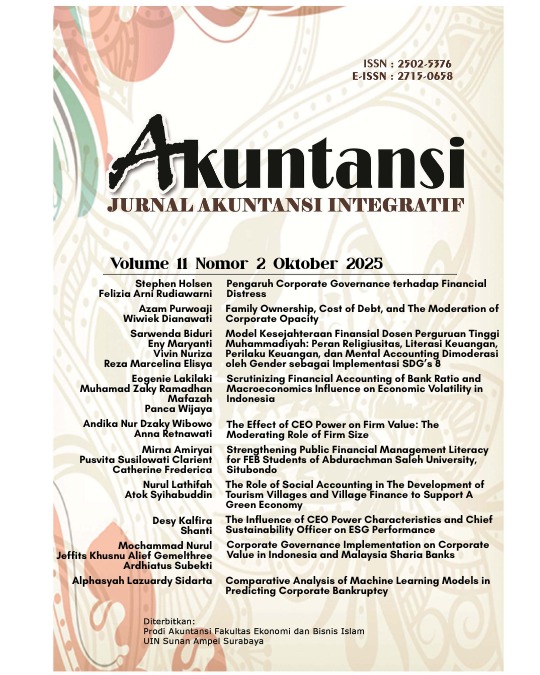
Family Ownership, Cost of Debt, and The Moderation of Corporate Opacity
DOI:
https://doi.org/10.29080/jai.v11i2.2029Keywords:
Family Ownership, Cost of Debt, Corporate OpacityAbstract
This study examines the moderating role of corporate opacity in the relationship between family ownership and the cost of debt in Indonesian manufacturing firms. Using a sample of 117 firms listed on the Indonesia Stock Exchange (IDX) from 2018–2020, the study employs multiple linear and moderated regression analysis. Results indicate that family ownership reduces the cost of debt, and this effect is significantly moderated by corporate opacity. The findings contribute to understanding the impact of transparency on debt financing in family owned firms, offering insights for lenders, regulators, and family businesses in managing financial strategies.
Downloads
References
Anderson, R. C., Mansi, S. A., & Reeb, D. M. (2003). Founding family ownership and the agency cost of debt. Journal of Financial Economics, 68(2), 263–285. https://doi.org/10.1016/S0304405X(03)000679
Aronoff, C. E., & Ward, J. L. (1995). FamilyOwned Businesses: A Thing of the Past or a Model for the Future? Family Business Review, 8(2), 121–130. https://doi.org/10.1111/j.17416248.1995.00121.x
Awaloedin, D. T., & Nugroho, R. (2019). The Influence of Company Size, Debt Ratio, and Company Age on the Cost of Debt (Study of Manufacturing Companies Listed on the Indonesian Stock Exchange in 20152017). Jurnal Rekayasa Informasi, 8, 60.
Bahrun, M. F., Tifah, & Firmasnyah, A. (2020). The Influence of Funding Decisions, Investment Decisions, Dividend Policy, and Free Cash Flow on Company Value. 263–266.
Damayanti, R., & Valianti, R. M. (2016). The Influence of Debt to Asset Ratio, Debt to Equity Ratio, Return on Assets and Net Profit Margin on Share Prices in LQ45 Index Companies on the Indonesian Stock Exchange. Jurnal Media Wahana Ekonomika, 13.
Donnelley, R. G. (1988). The Family Business. Family Business Review, 1(4), 427–445. https://doi.org/10.1111/j.17416248.1988.00427.x
Eisenhardt, K. M. (1989). Agency Theory: An Assessment and Review. The Academy of Management Review, 14(1), 57–74. https://doi.org/10.2307/258191
Firmansyah, A., Fauzi, I., & Yuniar, M. R. (2020). Cost of Debt from the Perspective of Dividend Policy, Profit Volatility and Quality of Accruals. Jurnal Studi Akuntansi Dan Keuangan , 3, 109–129.
Gao, H., He, J., Li, Y., & Qu, Y. (2020). Family control and cost of debt: Evidence from China. PacificBasin Finance Journal, 60, 101286. https://doi.org/10.1016/j.pacfin.2020.101286
Godlewski, C. J., & Le, N. H. (2021). Family firms and the cost of borrowing: empirical evidence from East Asia. Research in International Business and Finance, 60, 101570. https://doi.org/10.1016/j.ribaf.2021.101570
Jensen, M. C., & Meckling, W. H. (1976). Theory of the firm: Managerial behavior, agency costs and ownership structure. Journal of Financial Economics, 3(4), 305–360. https://doi.org/10.1016/0304405X(76)90026X
Lailiyah, A. (2014). The Urgency of 5C Analysis in Providing Banking Credit to Minimize Risk. Jurnal Yuridia, 29.
Lee, C.H., & Bose, S. (2021). Do family firms engage in less tax avoidance than nonfamily firms? The corporate opacity perspective. Journal of Contemporary Accounting & Economics, 17(2), 100263. https://doi.org/10.1016/j.jcae.2021.100263
Ma, L., Ma, S., & Tian, G. (2017). Corporate Opacity and Cost of Debt for Family Firms. European Accounting Review, 26(1), 27–59. https://doi.org/10.1080/09638180.2015.1087868
Masri, I., & Martani, D. (2014). Tax avoidance behaviour towards the cost of debt. Int. J. Trade and Global Markets, 7, 235–248.
Panda, B., & Leepsa, N. M. (2017). Agency theory: Review of Theory and Evidence on Problems and Perspectives. Indian Journal of Corporate Governance, 10(1), 74–95. https://doi.org/10.1177/0974686217701467
Paula. (2021). Tanggung Jawab Perseroan Terbatas Dalam Likuidasi. 4.
Pranata, J., Purwanto, M., & Lindrawati. (2019). The Influence of Family Ownership and Independent Directors on Company Performance.
Samsu. (2017). Metode Penelitian: (Teori dan Aplikasi Penelitian Kualitatif, Kuantitatif, Mixed Methods, serta Research & Development) (Rusmini, Ed.; 1st ed.). PUSAKA JAMBI.
Savitri, E. (2021). Political Connection, Family Ownership, and Earnings Management in Manufacturing Companies in Indonesia. Journal of Applied Management (JAM), 19.
Septian, M., & Panggabean, R. R. (2017). Factors That Influence the Cost of Debt in Companies in Kompas 100. Jurnal Ekonomi, 22, 37–51.
Setianto, R. H., & Sari, P. K. (2017). Family Companies and Dividend Policy in Indonesia. Jurnal Siasat Bisnis, 21(2), 107–118. https://doi.org/10.20885/jsb.vol21.iss2.art1
Sugiyono. (2013). Metode Penelitian Kuantitatif, Kualitatif, dan R&D (19th ed.). Alfabeta.
Susanto, A. B. (2005). World Class Family Business (1st ed.). Quantum Bisnis & Manajemen (PT Mizan Pustaka).
Swanpitak, T., Pan, X., & Suardi, S. (2020). Family control and cost of debt: Evidence from Thailand. PacificBasin Finance Journal, 62, 101376. https://doi.org/10.1016/j.pacfin.2020.101376
Swissia, P., & Purba, B. (2018). The Influence of Institutional Ownership Structure, Managerial Ownership, Family Ownership, Voluntary Disclosure and Leverage on the Cost of Debt. Jurnal Akuntansi & Keuangan, 9(2), 42–65.
Utamayasa, I. M. A. K., & Suputra, I. D. G. D. (2016). The Influence of Funding Sources and Investment Decisions on the Value of Property Sector Companies on the Indonesian Stock Exchange. EJurnal Ekonomi Dan Bisnis Universitas Udayana, 05.
Westhead, Paul. (1997). Ambitions, external environment and strategic factor differences between family and non–family companies. Entrepreneurship & Regional Development, 9(2), 127–158. https://doi.org/10.1080/08985629700000007
Yusnita, H. (2017). The Influence of Asset Growth, Sales Growth, Profitability and Taxes on Funding Sources in Manufacturing Companies Listed on the IDX for the 20132014 Period. JOM Fekon, 4, 193–206.
Downloads
Published
How to Cite
Issue
Section
License
Copyright (c) 2025 Azam Purwoaji, Wiwiek Dianawati

This work is licensed under a Creative Commons Attribution-ShareAlike 4.0 International License.