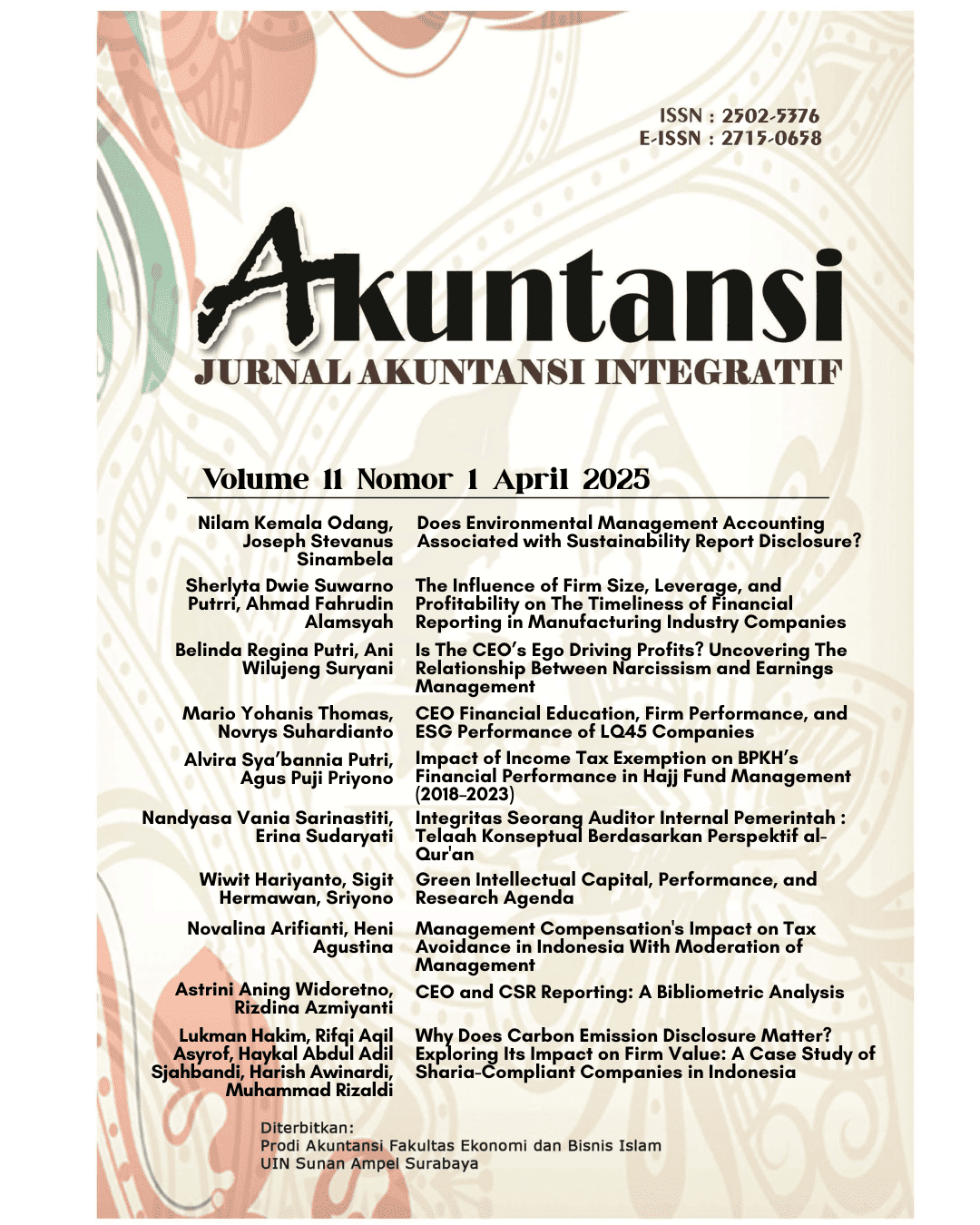
Does Environmental Management Accounting Associated with Sustainability Report Disclosure?
DOI:
https://doi.org/10.29080/jai.v11i01.2026Keywords:
Environmental Management Accounting, Sustainability Report Disclosure, Eco-efficiency IndexAbstract
This study examines the relationship between Environmental Management Accounting (EMA) and Sustainability Report Disclosure (SRD) in energy sector firms. As businesses face increasing environmental challenges, understanding how EMA contributes to transparency in sustainability reporting is crucial. Despite prior research on EMA and SRD individually, limited empirical evidence links their direct association. This study introduces a novel approach by incorporating Monetary Environmental Management Accounting (MEMA) and Physical Environmental Management Accounting (PEMA), along with the Eco-Efficiency Index (EEI), to measure the balance between financial and environmental performance. Using a quantitative approach with multiple regression analysis on energy sector firms listed in IDX year 2023, amounted 75 firms. it confirms that EMA and EEI positively associated with SRD. The study contributes to environmental accounting literature and provides practical implications for firms and policymakers to enhance sustainability disclosures. However, limitations in sector focus and data availability suggest avenues for future research.
Downloads
References
Beck, A. Cornelia, David Campbell, and Philip J. Shrives. 2010. “Content Analysis in Environmental Reporting Research: Enrichment and Rehearsal of the Method in a British-German Context.” British Accounting Review 42 (3): 207–22. https://doi.org/10.1016/j.bar.2010.05.002.
Burritt, Roger L., Tobias Hahn, and STefan Schaltegger. 2002. “Towards a Comprehensive Framework for Environmental Management Accounting — Links Between Business Actors and Environmental Management Accounting Tools.” Australian Accounting Review 12 (27): 39–50. https://doi.org/10.1111/j.1835-2561.2002.tb00202.x.
Cohen, Nevin, and Paul Robbins. 2011. Green Business: An A-to-Z Guide. 2455 Teller Road, Thousand Oaks California 91320 United States: SAGE Publications, Inc. https://doi.org/10.4135/9781412973793.
Dangelico, Rosa Maria, Devashish Pujari, and Pierpaolo Pontrandolfo. 2017. “Green Product Innovation in Manufacturing Firms: A Sustainability‐Oriented Dynamic Capability Perspective.” Business Strategy and the Environment 26 (4): 490–506. https://doi.org/10.1002/bse.1932.
Demirel, Pelin, and Effie Kesidou. 2019. “Sustainability‐oriented Capabilities for Eco‐innovation: Meeting the Regulatory, Technology, and Market Demands.” Business Strategy and the Environment 28 (5): 847–57. https://doi.org/10.1002/bse.2286.
Derchi, Giovanni-Battista, Antonio Davila, and Daniel Oyon. 2023. “Green Incentives for Environmental Goals.” Management Accounting Research 59 (June): 100830. https://doi.org/10.1016/j.mar.2022.100830.
Dura, Justita, and Riyanto Setiawan Suharsono. 2022. “Application Green Accounting To Sustainable Development Improve Financial Performance Study In Green Industry.” Jurnal Akuntansi 26 (2): 192–212. https://doi.org/10.24912/ja.v26i2.893.
Ferreira, Jorge, Arnaldo Coelho, and Luiz Moutinho. 2020. “Dynamic Capabilities, Creativity and Innovation Capability and Their Impact on Competitive Advantage and Firm Performance: The Moderating Role of Entrepreneurial Orientation.” Technovation 92–93 (April): 102061. https://doi.org/10.1016/j.technovation.2018.11.004.
Gerged, Ali Meftah, Nadia Zahoor, and Christopher J. Cowton. 2024. “Understanding the Relationship between Environmental Management Accounting and Firm Performance: The Role of Environmental Innovation and Stakeholder Integration – Evidence from a Developing Country.” Management Accounting Research 62 (March): 100865. https://doi.org/10.1016/j.mar.2023.100865.
Hashfi, Muhammad Hammam Al. 2024. “Beyond Sustainability: The ESG Performance Relationship on Earnings Management and Tax Avoidance.” Scientax 5 (2): 131–47. https://doi.org/10.52869/st.v5i2.771.
Hur, Tak, Tack Lim Song, and Hye-Jin Lee. 2003. “A Study on the Eco-Efficiencies for Recycling Methods of Plastic Wastes.” Konkuk University.
Ichimura, Masakazu, Sangmin Nam, Sophie Bonjour, Hitomi Rankine, Brian Carisma, Ying Qiu, and Rujira Khrueachotikul. 2009. “Eco-Efficiency Indicators: Measuring Resource-Use Efficiency and the Impact of Economic Activities on the Environment.” “Greening of Economic Growth” Series, 2009. https://sustainabledevelopment.un.org/content/documents/785eco.pdf.
Küçükoğlu, Mübeyyen Tepe. 2018. “The Mediating Role of Green Organizational Culture Between Sustainability and Green Innovation: A Research in Turkish Companies.” Business & Management Studies: An International Journal 6 (1): 64–85. https://doi.org/10.15295/bmij.v6i1.208.
Maama, Haruna, and Kingsley Opoku Appiah. 2019. “Green Accounting Practices: Lesson from an Emerging Economy.” Qualitative Research in Financial Markets 11 (4): 456–78. https://doi.org/10.1108/QRFM-02-2017-0013.
Mosaoy, Dunia Jaleel Jafer Al. 2023. “The Role of Environmental Management Accounting Information in the Design Process of Environmental and Sustainable Products.” International Journal of Engineering Business Management 15 (February). https://doi.org/10.1177/18479790231183511.
Nabila, Rifda. 2021. “Green Accounting for Sustainable Development: Case Study of Indonesia’s Manufacturing Sector.” Akuntansi Dewantara 5 (1): 1–10. https://doi.org/10.26460/ad.v5i1.9147.
Pratiwi, Yobi Nagoya, Inten Meutia, and Syamsurijal Syamsurijal. 2020. “The Effect of Environmental Management Accounting on Corporate Sustainability.” Binus Business Review 11 (1): 43–49. https://doi.org/10.21512/bbr.v11i1.6028.
Schaltegger, Stefan. 2018. “Linking Environmental Management Accounting: A Reflection on (Missing) Links to Sustainability and Planetary Boundaries.” Social and Environmental Accountability Journal 38 (1): 19–29. https://doi.org/10.1080/0969160X.2017.1395351.
Simbolon, Risna Sari, and Nilam Kemala Odang. 2024. “Sustainability Report Disclosure and Investor Reaction: An Explanatory Study on Infrastructure Sector Companies.” JRAM (Jurnal Riset Akuntansi Multiparadigma) 11 (2): 30–42. https://doi.org/http://dx.doi.org/10.30743/akutansi.v11i2.10122.
Solovida, Grace T., and Hengky Latan. 2017. “Linking Environmental Strategy to Environmental Performance.” Sustainability Accounting, Management and Policy Journal 8 (5): 595–619. https://doi.org/10.1108/SAMPJ-08-2016-0046.
Somantri, Arief Jatnika, and Ayi Mohammad Sudrajat. 2023. “Pengaruh Penerapan Green Accounting Dan Kinerja Lingkungan Terhadap Sustainable Development (Pada Perusahaan Manufaktur Sektor Industri Dasar Dan Kimia 2020-2022).” Jurnal Pendidikan Tambusai 7 (3). https://doi.org/https://doi.org/10.31004/jptam.v7i3.9899.
Syahputra, Doni, Herlina Helmy, and Erly Mulyani. 2019. “Analisis Pengungkapan Lingkungan Berdasarkan Global Reporting Initiatives (Gri) G4.” Jurnal Eksplorasi Akuntansi 1 (2): 678–93. https://doi.org/10.24036/jea.v1i2.102.
Thomas, Jake, Wentao Yao, Frank Zhang, and Wei Zhu. 2022. “Meet, Beat, and Pollute.” Review of Accounting Studies 27 (3): 1038–78. https://doi.org/10.1007/s11142-022-09694-0.
Wang, Tiantian, Kamisah Ismail, and Khairul Saidah Abas Azmi. 2022. “The Rise of MCS and EMA in the Sustainable Field: A Systematic Literature Analysis.” Sustainability 14 (24): 16532. https://doi.org/10.3390/su142416532.
Wardaningtyas, Dara, and Tjahjaning Poerwati. 2024. “Pengaruh Pengungkapan Sustainability Report, Green Accounting Dan Green Strategy Terhadap Kualitas Laporan Keuangan.” Jurnal Riset Akuntansi Politala 7 (2): 518–29. https://doi.org/10.34128/jra.v7i2.371.
Downloads
Published
How to Cite
Issue
Section
License
Copyright (c) 2025 Nilam Kemala Odang, Joseph Stevanus Sinambela

This work is licensed under a Creative Commons Attribution-ShareAlike 4.0 International License.