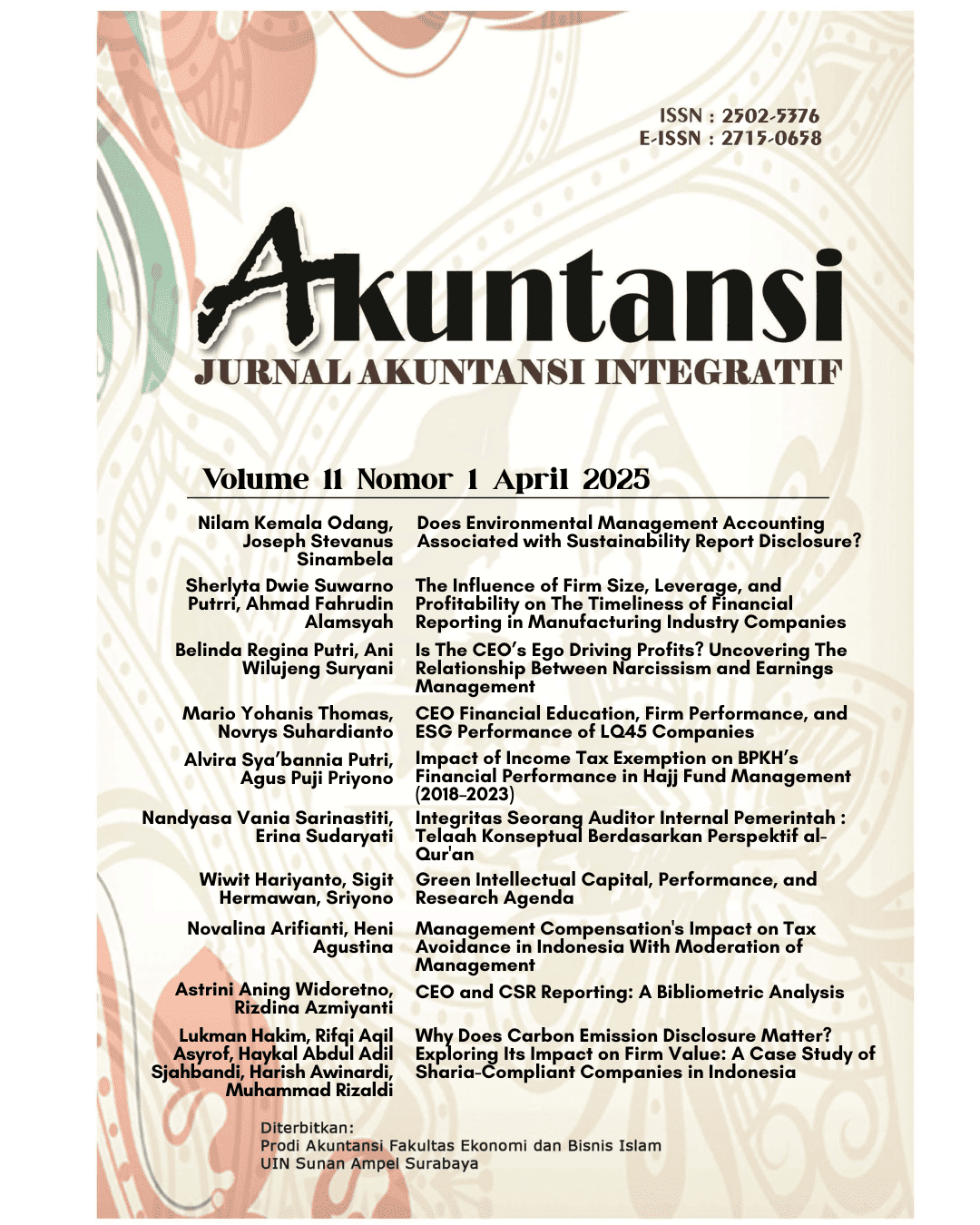
Integritas Seorang Auditor Internal Pemerintah : Telaah Konseptual Berdasarkan Perspektif al-Qur'an
DOI:
https://doi.org/10.29080/jai.v11i01.2013Keywords:
Integrity, Government Internal Auditor, Al-Qur'an, Honesty, EthicsAbstract
This study examines the concept of integrity of government internal auditors from the perspective of the Qur'an with a hermeneutic approach. The Qur'an provides a strong moral foundation in instilling integrity, which includes honesty, responsibility, and accountability. In the context of the auditor profession, integrity serves as the main guideline to ensure transparency and fairness in the performance of duties. This study found that Islamic values contained in the Qur'an, such as honesty in QS. Al-Baqarah: 42, fulfillment of trust in QS. An-Nisa: 58, and justice in QS. Al-Ma'idah: 8, are relevant to strengthen the professional ethics of auditors. This research is expected to contribute to the development of an auditor code of ethics based on Islamic religiosity values to support clean and transparent governance.
Keywords: Integrity, Government Internal Auditor, Al-Qur'an, Honesty, Ethics
Downloads
References
Abbas, Dirvi Surya, Tubagus Ismail, Muhamad Taqi, and Helmi Yazid. 2021. “The Influence of Independent Commissioners, Audit Committee and Company Size on the Integrity of Financial Statements.” Estudios de Economia Aplicada 39 (10). https://doi.org/10.25115/eea.v39i10.5339.
Agama, Kementrian. 2022. “Qur’an Kemenag.” 2022. https://quran.kemenag.go.id/.
Ahmad, Hasbullah. 2021. “Integrasi Al-Qur’an Dan Ilmu Sosial (Kontekstualitas Al-Qur’an Dalam Kehidupan Bermasyarakat).” Ulumul Qur’an: Jurnal Kajian Ilmu Al-Qur’an Dan Tafsir 1 (2): 1–15. https://doi.org/10.58404/uq.v1i2.69.
Albitar, Khaldoon, Ali Meftah Gerged, Hassan Kikhia, and Khaled Hussainey. 2021. “Auditing in Times of Social Distancing: The Effect of COVID-19 on Auditing Quality.” International Journal of Accounting and Information Management 29 (1): 169–78. https://doi.org/10.1108/IJAIM-08-2020-0128.
Alsughayer, Sulaiman A. 2021. “Impact of Auditor Competence, Integrity, and Ethics on Audit Quality in Saudi Arabia.” Open Journal of Accounting 10 (04): 125–40. https://doi.org/10.4236/ojacct.2021.104011.
Asmara, Wisnu Widya, and Hamidah Hamidah. 2022. “Optimalisasi Kode Etik Aparat Pengawasan Intern Pemerintah (Apip): Meneladani Sifat Rasulullah Saw.” EKUITAS (Jurnal Ekonomi Dan Keuangan) 6 (2): 271–91. https://doi.org/10.24034/j25485024.y2022.v6.i2.5233.
Dewi, Herlin Angela. 2022. “Independensi Aparat Pengawas Intern Pemerintah Guna Pelaksanaan Good Governance Berbasis CACM Di Lingkungan Pemerintah Daerah.” Arena Hukum 15 (2): 399–422. https://doi.org/10.21776/ub.arenahukum.2022.01502.9.
Dyhati, Anggun Soraya, and Tertiarto Wahyudi. 2022. “The Effect of Integrity, Objectivity and Management Support on the Effectiveness of Internal Audit of The Government Sector in The Covid-19 Pandemic Condition.” Journal of Accounting Finance and Auditing Studies (JAFAS), 197–218. https://doi.org/10.32602/jafas.2022.033.
Efferin, Sujoko, and Christopher Christian Hutomo. 2021. “Spirituality, Happiness and Auditors’ Commitment: An Interbeing Perspective.” Accounting, Auditing and Accountability Journal 34 (4): 701–30. https://doi.org/10.1108/AAAJ-01-2020-4385.
Fathallah, Ramzi, Yusuf Sidani, and Sandra Khalil. 2020. “How Religion Shapes Family Business Ethical Behaviors: An Institutional Logics Perspective.” Journal of Business Ethics 163 (4): 647–59. https://doi.org/10.1007/s10551-019-04383-6.
Haron, Hasnah, Nurul Nazlia Jamil, and Nathasa Mazna Ramli. 2020. “Western and Islamic Values and Ethics: Are They Different?” Journal of Governance and Integrity 4 (1): 12–28. https://doi.org/10.15282/jgi.4.1.2020.5609.
Herasymiuk, Kostiantyn, Oleg V. Martselyak, Yuliya N. Kirichenko, Nataliya V. Zhmur, and Iuliia I. Shmalenko. 2020. “Principles of Integrity and Good Governance in Public Administration.” International Journal of Management 11 (4): 545–55. https://doi.org/10.34218/IJM.11.4.2020.052.
Herijanto, Hendy. 2022. “Al Amanah in Al Qur’an vs Trust: A Comparative Study.” International Journal of Ethics and Systems 38 (4): 549–75. https://doi.org/10.1108/IJOES-03-2021-0064.
Hossain, Khandakar Akhter. 2023. “EVALUATION OF ETHICAL VALUES TO DEVELOP GLOBAL HUMAN RESOURCE.” Journal of Liberal Arts and Humanities (JLAH) 4 (5): 1–29. https://doi.org/10.48150/jlah.v4no5.2023.a1.
Jeppesen, Kim K. 2019. “The Role of Auditing in the Fight against Corruption.” British Accounting Review 51 (5). https://doi.org/10.1016/j.bar.2018.06.001.
Khairuldin, W. M.K.F.W., W. N.I.W.N. Anas, A. H. Embong, S. A. Hassan, M. A. Suhaimi, and M. A. Idham. 2024. “A Holistic Islamic-Based Academic Integrity Model for Higher Education Institutions in Malaysia.” Global Journal Al-Thaqafah DECEMBER2024 (SPECIALISSUE): 193–207. https://doi.org/10.7187/GJATSI122024-13.
Khalid, Azam Abdelhakeem, and Adel M. Sarea. 2021. “Independence and Effectiveness in Internal Shariah Audit with Insights Drawn from Islamic Agency Theory.” International Journal of Law and Management 63 (3): 332–46. https://doi.org/10.1108/IJLMA-02-2020-0056.
Koerniawati, Dwi. 2021. “The Remote and Agile Auditing: A Fraud Prevention Effort To Navigate the Audit Process in the Covid-19 Pandemic.” Jurnal Riset Akuntansi Dan Bisnis Airlangga 6 (2): 1131–49. https://doi.org/10.20473/jraba.v6i2.208.
KPK. 2023. “Laporan Tahunan KPK 2023.” Angewandte Chemie International Edition, 6(11), 951–952., 5–24.
Liyanapathirana, Nirupika, and Chris Akroyd. 2023. “Religiosity and Accountants’ Ethical Decision-Making in a Religious Country with a High Level of Corruption.” Pacific Accounting Review 35 (2): 181–98. https://doi.org/10.1108/PAR-08-2021-0132.
Marciano, Benny, Ardiansyah Syam, Suyanto, and Nurmala Ahmar. 2021. “Penerapan Pengendalian Internal Terhadap Kecurangan: Sebuah Literatur Review.” WACANA EKONOMI (Jurnal Ekonomi, Bisnis Dan Akuntansi) 20 (2): 130–37. https://doi.org/10.22225/we.20.2.2021.130-137.
Masdar, Rahma, Andi Chairil Furqan, Masruddin Masruddin, and Lucyani Meldawaty. 2021. “The Role of Transparency and Professional Assistance in Regional Financial Management in the Indonesian Regional Governments.” Journal of Public Affairs 21 (3). https://doi.org/10.1002/pa.2666.
Mohd Zin, M Z, Mohd Syahiran, Abdul Latif, Nurfahiratul Azlina Ahmad, and Rohaya Sulaiman. 2021. “Relationship between Muslim Accountability Enhancement and Religious Practices Appreciation.” Journal of Multidisciplinary Islamic Studies 1 (2): 7–14. www.majmuah.com.
Mostafa, Diana, Mostaq Hussain, and Ehab K.A. Mohamed. 2020. “The Effect of Religiosity–Morality Interaction on Auditor Independence in Egypt.” Managerial Auditing Journal 35 (8): 1009–31. https://doi.org/10.1108/MAJ-04-2019-2267.
Murshidi, Ghadah Al, Muhammad Fazlurrahman Hadi, Miftachul Huda, and Terence Lovat. 2024. “The Development of Islamic Education Curriculum from the Quranic Perspective” 1 (2): 93–123.
Nurfahmiyati, Zainuddin Maliki, Sri Iswati, Rofi Rofaida, and Harlina Meidiaswati. 2020. “The Linkage of Competence, Professionalism and Islamic Work Ethic: A Literature Review.” Journal of Innovation in Business and Economics 4 (1): 31–38. http://ejournal.umm.ac.id/index.php/jibe.
Qadoos, Abdul, and Murat Simsek. 2020. “Ways for Peaceful Society in Islamic Law.” IJISH (International Journal of Islamic Studies and Humanities) 3 (1): 32–37. https://doi.org/10.26555/ijish.v3i1.1913.
Rayyes, Fishal. 2023. “Reflecting the Nature of the Prophet Muhammad on the Ethics of Internal Auditors.” Jurnal Samudra Ekonomi Dan Bisnis 14 (2): 290–303. https://doi.org/10.33059/jseb.v14i2.6239.
Ridwan, M. K., and Siti Robikah. 2019. “Ethical Vision of the Qur’an (Interpreting Concept of the Qur’Anic Sociology in Developing Religious Harmony).” Jurnal Ilmiah Islam Futura 19 (2): 308–26. https://doi.org/10.22373/jiif.v19i2.5444.
Rosidi, Rosidi, Zaki Baridwan, and Intan Lifinda Ayuning Putri. 2023. “Apakah Audit Internal Berperan Dalam Pencegahan Korupsi?” Jurnal Akuntansi Multiparadigma 14 (1): 138–48. https://doi.org/10.21776/ub.jamal.2023.14.1.10.
Salin, Ahmad Saiful Azlin Puteh, Siti Khadijah Ab Manan, and Norlela Kamaluddin. 2020. “Ethical Framework for Directors – Learning from the Prophet.” International Journal of Law and Management 62 (2): 171–91. https://doi.org/10.1108/IJLMA-04-2018-0075.
Sam, Dewi Fortuna, Mr. Sumarlin, and Mr. Suhartono. 2019. “Islamic Religiosity Integration in Maintaining Auditor Professional Ethics” 308 (Insyma): 79–82. https://doi.org/10.2991/insyma-19.2019.20.
Saptono, Prianto Budi, and Dwi Purwanto. 2022. “Analysis of Good Corporate Governance’s Ineffectiveness in Preventing Corruption in BUMN.” Integritas : Jurnal Antikorupsi 8 (1): 77–94. https://jurnal.kpk.go.id/index.php/integritas/article/view/870.
Schleiermacher, Friedrich. 1998. Friedrich Schleiermacher Hermeneutics and Criticism. Friedrich Schleiermacher Hermeneutics and Criticism. https://doi.org/10.1017/cbo9780511814945.
Shah, Syed Sibghatullah, and Zahid Asghar. 2024. “Individual Attitudes towards Environmentally Friendly Choices: A Comprehensive Analysis of the Role of Legal Rules, Religion, and Confidence in Government.” Journal of Environmental Studies and Sciences, 629–51. https://doi.org/10.1007/s13412-024-00913-5.
Tuan Mansor, Tuan Mastiniwati, Akmalia Mohamad Ariff, and Hafiza Aishah Hashim. 2020. “Whistleblowing by Auditors: The Role of Professional Commitment and Independence Commitment.” Managerial Auditing Journal 35 (8): 1033–55. https://doi.org/10.1108/MAJ-11-2019-2484.
Tudor, Adriana, and Delia Deliu. 2022. Reflections on the Human-Algorithm Complex Duality Perspectives in the Auditing Process. Qualitative Research in Accounting and Management. Vol. 19. https://doi.org/10.1108/QRAM-04-2021-0059.
Uyar, Ali, Cemil Kuzey, Ali Haydar Güngörmüs, and Ruth Alas. 2015. “Influence of Theory, Seniority, and Religiosity on the Ethical Awareness of Accountants.” Social Responsibility Journal 11 (3): 590–604. https://doi.org/10.1108/SRJ-06-2014-0073.
Viphoouparakhot, V. 2021. “Dialogue for Proposing Guideline for Development of Social Responsibility in Terms of Morality, Integrity and Professional Code of Ethics of School Administrators in Thailand.” Journal of Community Development Research (Humanities and Social Sciences) 14 (2): 63–76.
Wahab, Mastura Ab. 2022. “Islamic Spiritual and Emotional Intelligence and Its Relationship to Eternal Happiness: A Conceptual Paper.” Journal of Religion and Health 61 (6): 4783–4806. https://doi.org/10.1007/s10943-021-01485-2.
Yunus, Ruslan Moh., Muhammad Yusuf Wibisono, and Dody S. Truna. 2024. “Structural Model of Religiosity of the Engineering Profession of the Indonesian Engineers Association.” Hanifiya: Jurnal Studi Agama-Agama 7 (1): 263–84. https://doi.org/10.15575/hanifiya.v7i2.37969.
Zahari, Afzal Izzaz, Jamaliah Said, and Roshayani Arshad. 2022. “Examining the Components of Integrity.” Integrative Psychological and Behavioral Science 56 (1): 234–65. https://doi.org/10.1007/s12124-021-09626-8.
Zaim, Halil, Erdem Erzurum, Selim Zaim, Burhan Uluyol, and Gökhan Seçgin. 2024. “The Influence of Islamic Leadership on Work Performance in Service Industry: An Empirical Analysis.” International Journal of Ethics and Systems 40 (1): 127–52. https://doi.org/10.1108/IJOES-12-2021-0242.
Downloads
Published
How to Cite
Issue
Section
License
Copyright (c) 2025 Nandyasa Vania Sarinastiti, Erina Sudaryati

This work is licensed under a Creative Commons Attribution-ShareAlike 4.0 International License.