
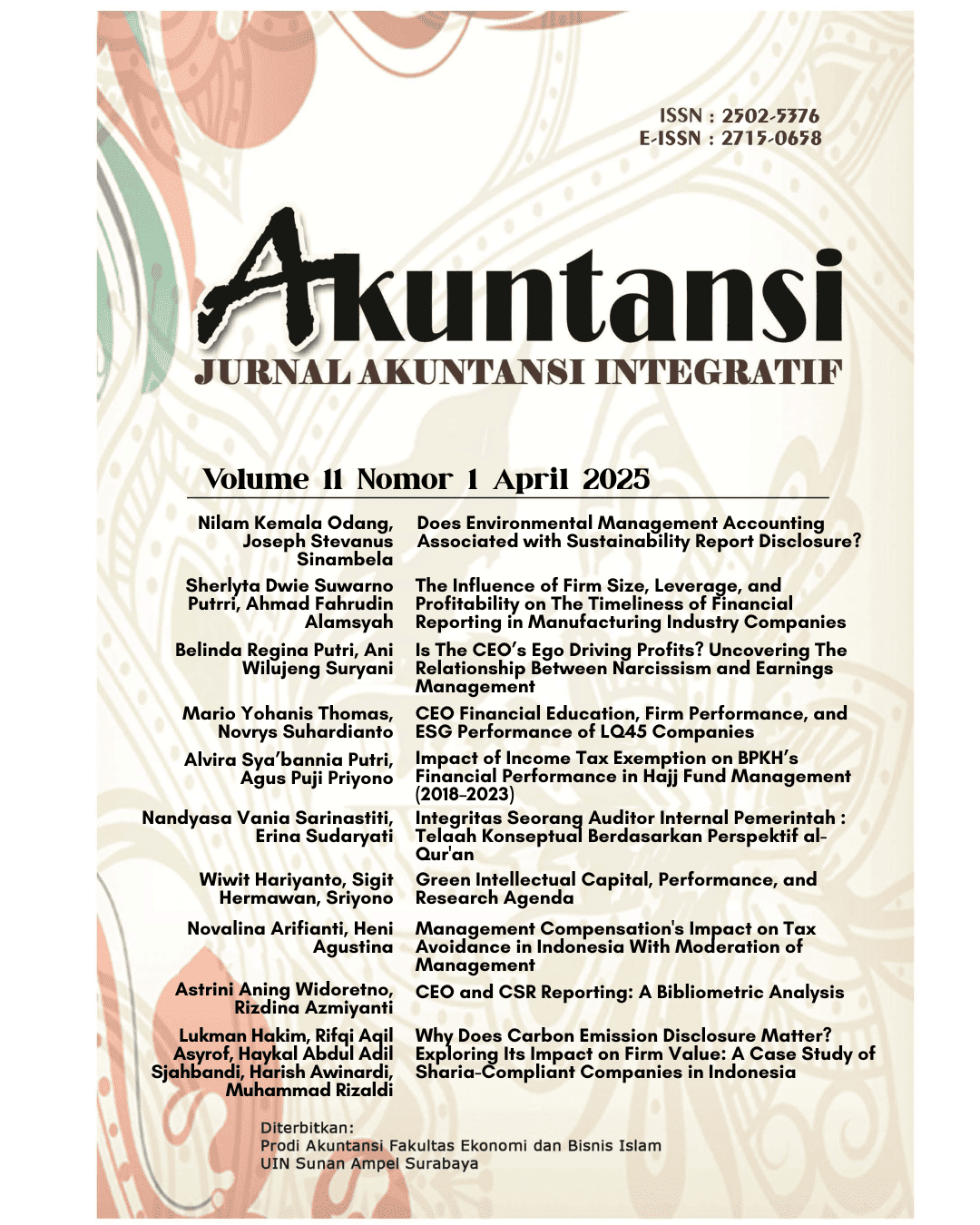
CEO Financial Education, Firm Performance, and ESG Performance of LQ45 Companies
DOI:
https://doi.org/10.29080/jai.v11i01.2010Keywords:
Corporate Governance, ESG Performance, Financial Education, Firm Performance, LQ45Abstract
Financial education that emphasizes only economic perspectives and moral hazard tends to make CEOs with financial expertise highly profit-oriented. Therefore, it is important to identify the influence of a financial education background on the financial performance of LQ45 companies, as well as the role of ESG performance in moderating this relationship. The analysis was conducted using Multiple Least Squares Regression and Moderated Regression Analysis on 166 observations indexed in LQ45 from 2017 to 2022. The results of the analysis indicate that the financial expertise of the CEO has a positive effect on financial performance, and ESG performance weakens this influence. This study's findings have practical implications, suggesting that ESG performance can serve as a governance mechanism to mitigate extreme profit orientation, allowing for the optimization of non-financial aspects such as the company's ESG performance.
Downloads
References
Adams, M., & Jiang, W. (2017). Do chief executives’ traits affect the financial performance of risk-trading firms? evidence from the UK insurance industry. British Journal of Management, 28(3), 481–501. https://doi.org/10.1111/1467-8551.12222
Agle, B. R., Mitchell, R. K., & Sonnenfeld, J. A. (1999a). Who matters to CEOs? An investigation of stakeholder attributes and salience, corporate performance, and CEO values. Academy of Management Journal, 42(5), 507–525. https://www.jstor.org/stable/256973
Agle, B. R., Mitchell, R. K., & Sonnenfeld, J. A. (1999b). Who Matters to CEOs? An Investigation of Stakeholder Attributes and Salience, Corporate Performance, and CEO Values. In Source: The Academy of Management Journal (Vol. 42, Issue 5). https://www.jstor.org/stable/256973
Ahmad, N., Mobarek, A., & Raid, M. (2023). Impact of global financial crisis on firm performance in UK: Moderating role of ESG, corporate governance and firm size. Cogent Business and Management, 10(1). https://doi.org/10.1080/23311975.2023.2167548
Ahmed, M. S., & Kumar, S. (2023). Are MBA CEOs really more risk-averse? International Review of Financial Analysis, 89. https://doi.org/10.1016/j.irfa.2023.102804
Al-ahdal, W. M., & Hashim, H. A. (2022). Impact of audit committee characteristics and external audit quality on firm performance: evidence from India. Corporate Governance (Bingley), 22(2), 424–445. https://doi.org/10.1108/CG-09-2020-0420
Ali, R., Rehman, R. U., Suleman, S., & Ntim, C. G. (2022). CEO attributes, investment decisions, and firm performance: New insights from upper echelons theory. Managerial and Decision Economics, 43(2), 398–417. https://doi.org/10.1002/mde.3389
Al-Jalahma, A. (2022). Impact of audit committee characteristics on firm performance: Evidence from Bahrain. Problems and Perspectives in Management, 20(1), 247–261. https://doi.org/10.21511/ppm.20(1).2022.21
Amedu, S., & Dulewicz, V. (2018). The relationship between CEO personal power, CEO competencies, and company performance. Journal of General Management, 43(4), 188–198. https://doi.org/10.1177/0306307018762699
Ananzeh, H., Al Shbail, M. O., Alshurafat, H., & Al Amosh, H. (2024). A cross-country examination on the relationship between cash holding, dividend policies, and the moderating role of ESG ratings. Cogent Business and Management, 11(1). https://doi.org/10.1080/23311975.2023.2300523
Bernile, G., Bhagwat, V., & Rau, P. R. (2017). What doesn’t kill you will only make you more risk-loving: Early-life disasters and CEO behavior. The Journal of Finance, 72(1), 167–206.
Bukari, A., Agyemang, A. O., & Bawuah, B. (2024). Assessing the moderating role of ESG performance on corporate governance and firm value in developing countries. Cogent Business and Management, 11(1). https://doi.org/10.1080/23311975.2024.2333941
Das, N. C., Chowdhury, M. A. F., & Islam, M. N. (2022). The heterogeneous impact of leverage on firm performance: empirical evidence from Bangladesh. South Asian Journal of Business Studies, 11(2), 235–252. https://doi.org/10.1108/SAJBS-04-2020-0100
EBA. (2025). https://www.eba.europa.eu/sites/default/files/document_library/Publications/Consultations/2021/Consultation%20on%20draft%20ITS%20on%20Pillar%20disclosures%20on%20ESG%20risk/963626/Factsheet%20-%20ESG%20disclosures.pdf. Environmental Social and Governance Disclosures. https://doi.org/10.2853/835092
Elamer, A. A., Boulhaga, M., & Ibrahim, B. A. (2024). Corporate tax avoidance and firm value: The moderating role of environmental, social, and governance (ESG) ratings. Business Strategy and the Environment. https://doi.org/10.1002/bse.3881
E-Vahdati, S., & Binesh, F. (2022). The impact of CEO’s attributes on R&D intensity and ESG practices. Spanish Journal of Finance and Accounting / Revista Española de Financiación y Contabilidad, 51(3), 326–349. https://doi.org/10.1080/02102412.2021.1944459
Fariha, R., Hossain, M. M., & Ghosh, R. (2022). Board characteristics, audit committee attributes and firm performance: empirical evidence from emerging economy. Asian Journal of Accounting Research, 7(1), 84–96. https://doi.org/10.1108/AJAR-11-2020-0115
Fatemi, A., Glaum, M., & Kaiser, S. (2018). ESG performance and firm value: The moderating role of disclosure. Global Finance Journal, 38, 45–64. https://doi.org/10.1016/j.gfj.2017.03.001
Fernández Méndez, C., Arrondo García, R., & Pathan, S. (2017). Capacidad supervisora de los consejeros ocupadosy solapados: Un análisis de la remuneración ejecutiva yla calidad de la información financiera. Revista Espanola de Financiacion y Contabilidad, 46(1), 28–62. https://doi.org/10.1080/02102412.2016.1250345
Ghardallou, W. (2022). Corporate Sustainability and Firm Performance: The Moderating Role of CEO Education and Tenure. Sustainability (Switzerland), 14(6). https://doi.org/10.3390/su14063513
Ghardallou, W. (2023). The heterogeneous effect of leverage on firm performance: a quantile regression analysis. International Journal of Islamic and Middle Eastern Finance and Management, 16(1), 210–225. https://doi.org/10.1108/IMEFM-12-2021-0490
Ghoshal, S. (2005a). Bad management theories are destroying good management practices. Academy of Management Learning & Education, 4(1), 75–91. https://about.jstor.org/terms
Ghoshal, S. (2005b). Bad Management Theories Are Destroying Good Management Practices. In Source: Academy of Management Learning & Education (Vol. 4, Issue 1). https://about.jstor.org/terms
Giacalone, R. A., & Thompson, K. R. (2006a). Business ethics and social responsibility education: Shifting the worldview. Academy of Management Learning & Education, 5(3), 266–277. https://www.jstor.org/stable/40214381
Giacalone, R. A., & Thompson, K. R. (2006b). Business Ethics and Social Responsibility Education: Shifting the Worldview. In Management Learning & Education (Vol. 5, Issue 3). https://www.jstor.org/stable/40214381
Gupta, N., & Mahakud, J. (2020). CEO characteristics and bank performance: evidence from India. Managerial Auditing Journal, 35(8), 1057–1093. https://doi.org/10.1108/MAJ-03-2019-2224
Hambrick, D. C., & Mason, P. A. (1984a). Upper Echelons: The Organization as a Reflection of Its Top Managers. In Source: The Academy of Management Review (Vol. 9, Issue 2).
Hambrick, D. C., & Mason, P. A. (1984b). Upper Echelons: The Organization as a Reflection of Its Top Managers. In Source: The Academy of Management Review (Vol. 9, Issue 2).
Harymawan, I., Nasih, M., Ratri, M. C., & Nowland, J. (2019). CEO busyness and firm performance: evidence from Indonesia. Heliyon, 5(5). https://doi.org/10.1016/j.heliyon.2019.e01601
Hasti, W. W., Maryani, M., & Makshun, A. (2022). Pengaruh Leverage, Struktur Modal, dan Ukuran Perusahaan terhadap Kinerja Keuangan pada Perusahaan Sektor Pertambangan. Reviu Akuntansi, Manajemen, Dan Bisnis, 2(2), 139–150. https://doi.org/10.35912/rambis.v2i2.1544
Jensen, M. C., & Meckling, W. H. (1976). Theory of the firm: Managerial behavior, agency costs and ownership structure. Journal of Financial Economics, 3, 305–360.
Jorgji, S., Teta, J., Mousa, S., Ponkratov, V., Elyakova, I., Vatutina, L., Pozdnyaev, A., Chernysheva, T., Romanenko, E., & Kosov, M. (2024). Sustainable Human Capital Management, ESG, and Firm Performance: Moderating Role of ESG Disclosure. Journal of Human, Earth, and Future, 5(2). www.HEFJournal.org
Kyere, M., & Ausloos, M. (2021). Corporate governance and firms financial performance in the United Kingdom. International Journal of Finance and Economics, 26(2), 1871–1885. https://doi.org/10.1002/ijfe.1883
Lin, P., Lin, B., & Lei, F. (2020). Influence of CEO Characteristics on Accounting Information Disclosure Quality—Based on the Mediating Effect of Capital Structure. Emerging Markets Finance and Trade, 56(8), 1781–1803. https://doi.org/10.1080/1540496X.2019.1698419
Lin, P. T., Jin, Y., Gao, F., Yang, R., & Lin, Q. (2023). Institutional Investors, CSR Report Readability and the Moderating Role of ESG Performance. SAGE Open, 13(4). https://doi.org/10.1177/21582440231208514
McCabe, D. L., Butterfield, K. D., & Treviño, L. K. (2006). Academic dishonesty in graduate business programs: Prevalence, causes, and proposed action. Academy of Management Learning & Education, 5(3), 294–305. https://about.jstor.org/terms
Mccabe, D. L., & Trevino, L. K. (1995). Cheating among business students: A challenge for business leaders and educators. Journal of Management Education, 19(2), 205–218.
Musa, A., Abdul Latif, R., & Abdul Majid, J. (2023). CEO attributes, board independence, and real earnings management: Evidence from Nigeria. Cogent Business and Management, 10(1). https://doi.org/10.1080/23311975.2023.2194464
Naseem, M. A., Lin, J., Rehman, R. ur, Ahmad, M. I., & Ali, R. (2020). Does capital structure mediate the link between CEO characteristics and firm performance? Management Decision, 58(1), 164–181. https://doi.org/10.1108/MD-05-2018-0594
Nguyen, Q. M., & Nguyen, C. V. (2024). Corporate governance, audit quality and firm performance–an empirical evidence. Cogent Economics and Finance, 12(1). https://doi.org/10.1080/23322039.2024.2334128
Oradi, J., Asiaei, K., & Rezaee, Z. (2020). CEO financial background and internal control weaknesses. Corporate Governance: An International Review, 28(2), 119–140. https://doi.org/10.1111/corg.12305
Palepu, K. G., Healy, P. M., & Peek, E. (2019). Business analysis and valuation: IFRS standard edition, 5th edition (5th ed.). CENGAGE Learning EMEA. www.cengage.com/highered
Pham, N. H. (2023). CEO characteristics and bank performance: Case of Vietnamese commercial banks. Cogent Economics and Finance, 11(1). https://doi.org/10.1080/23322039.2022.2162687
PRI. (2025). https://www.unpri.org/an-introduction-to-responsible-investment/what-is-responsible-investment/4780.article. What Is Responsible Investment? https://www.unpri.org/an-introduction-to-responsible-investment/what-is-responsible-investment/4780.article
Rath, C., & Deo, M. (2023). The moderating role of ESG disclosure scores in determining the impact of firm performance on CEO pay: a dynamic panel approach. In Int. J. Corporate Governance (Vol. 13, Issue 3).
Sharma, S., Durand, R. M., & Gur-Arie, O. (1981). Identification and analysis of moderator variables. Journal of Marketing Research, 18(3), 291–300.
Shleifer, A., & Vishny, R. W. (1997). A Survey of Corporate Governance. In Source: The Journal of Finance (Vol. 52, Issue 2).
Soschinski, C. K., Mazzioni, S., Dal Magro, C. B., & Leite, M. (2024). Corporate controversies and market-to-book: the moderating role of ESG practices. Revista Brasileira de Gestao de Negocios, 26(1). https://doi.org/10.7819/rbgn.v26i01.4255
Sun, H., Zhu, J., Wang, T., & Wang, Y. (2021). MBA CEOs and corporate social responsibility: Empirical evidence from China. Journal of Cleaner Production, 290. https://doi.org/10.1016/j.jclepro.2021.125801
Sun, W., Chen, S., Jiao, Y., & Feng, X. (2024). How does ESG constrain corporate earnings management? Evidence from China. Finance Research Letters, 61. https://doi.org/10.1016/j.frl.2024.104983
Velte, P. (2016). Women on management board and ESG performance. Journal of Global Responsibility, 7(1), 98–109. https://doi.org/10.1108/JGR-01-2016-0001
Velte, P. (2019). The bidirectional relationship between ESG performance and earnings management – empirical evidence from Germany. Journal of Global Responsibility, 10(4), 322–338. https://doi.org/10.1108/JGR-01-2019-0001
Wei, Q. (2021). CEO power and nonprofit financial performance: Evidence from Chinese philanthropic foundations. Voluntas, 32(2), 460–476. https://doi.org/10.1007/s11266-019-00187-4
Williams, R. J., Douglas Barrett, J., & Brabston, M. (2000). Managers’ business school education and military service: Possible links to corporate criminal activity. Human Relations, 53(5), 691–712.
Wood, D. J. (1991). Corporate social performance revisited. The Academy of Management Review, 16(4), 691–718. https://www.jstor.org/stable/258977
You, Y., Srinivasan, S., Pauwels, K., & Joshi, A. (2020). How CEO/CMO characteristics affect innovation and stock returns: findings and future directions. In Journal of the Academy of Marketing Science (Vol. 48, Issue 6, pp. 1229–1253). Springer. https://doi.org/10.1007/s11747-020-00732-4
Zhou, M., Chen, F., & Chen, Z. (2021a). Can CEO education promote environmental innovation: Evidence from Chinese enterprises. Journal of Cleaner Production, 297. https://doi.org/10.1016/j.jclepro.2021.126725
Zhou, M., Chen, F., & Chen, Z. (2021b). Can CEO education promote environmental innovation: Evidence from Chinese enterprises. Journal of Cleaner Production, 297. https://doi.org/10.1016/j.jclepro.2021.126725
Downloads
Published
How to Cite
Issue
Section
License
Copyright (c) 2025 Mario Yohanis Thomas, Novrys Suhardianto

This work is licensed under a Creative Commons Attribution-ShareAlike 4.0 International License.