
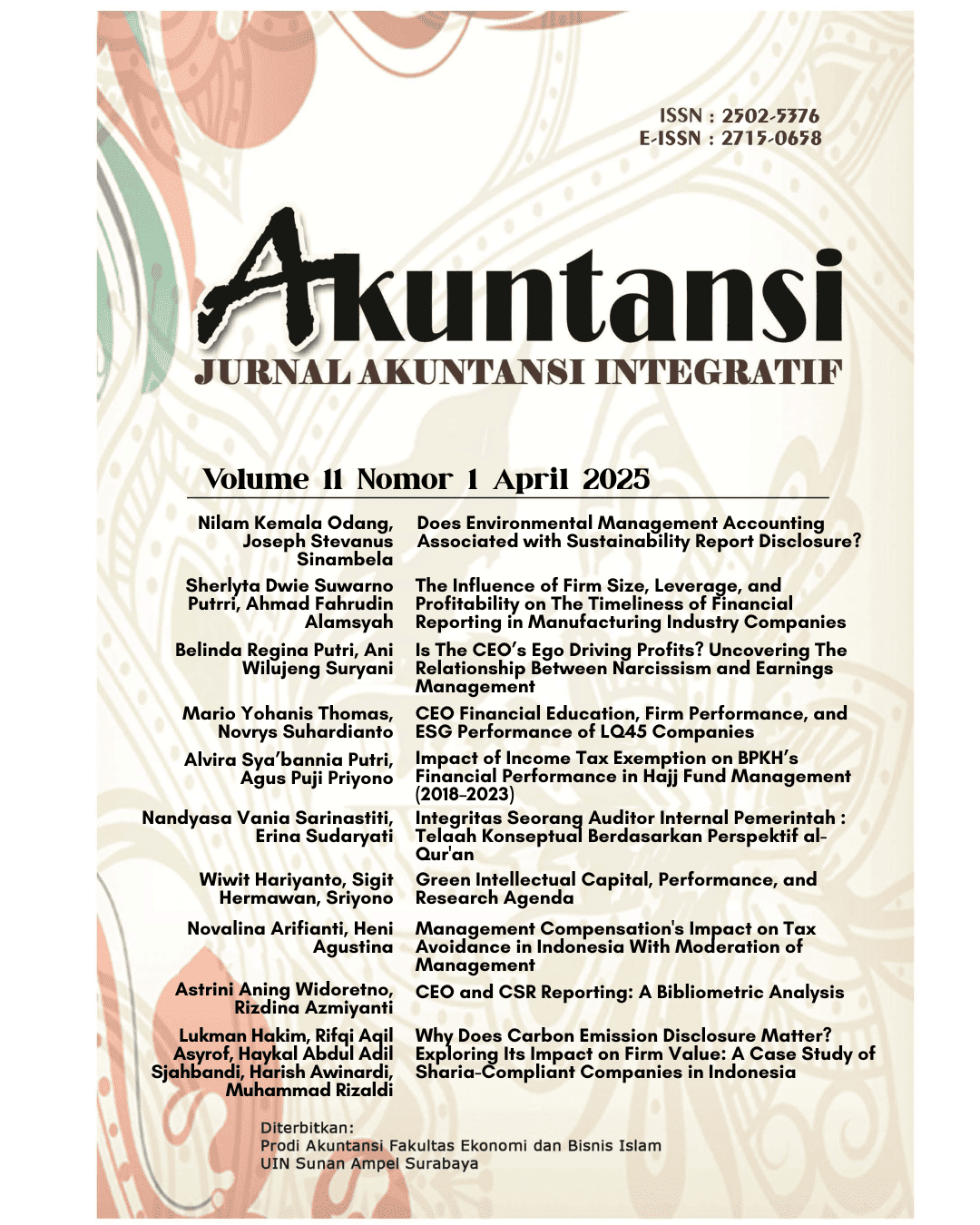
Is The CEO’s Ego Driving Profits? Uncovering The Relationship Between Narcissism and Earnings Management
DOI:
https://doi.org/10.29080/jai.v11i01.2002Keywords:
CEO Narcissism, Earning Management, Photo, Real Earnings ManagementAbstract
Globalization intensifies competition, pressuring profit margins and challenging companies to outperform competitors. This demands precise decision-making by Chief Executive Officers (CEOs), whose personalities influence their perceptions and strategies. This study examines the impact of CEO narcissism and tenure length on earnings management in 180 manufacturing companies listed on the IDX during 2015–2019. Using Generalized Least Square regression, the findings reveal that CEO narcissism, measured through photographs in annual reports, positively affects earnings management, while tenure length has no significant impact. By analyzing visual elements in annual reports as a proxy for narcissistic traits, this research offers a novel lens to explore how CEO psychology drives financial decisions. The results suggest narcissistic CEOs are more likely to manipulate earnings to gain recognition and validation. Investors should therefore assess management personalities through annual reports alongside financial metrics to make informed investment decisions.
Downloads
References
Agnihotri, A., & Bhattacharya, S. (2019). CEO Narcissism and Internationalization by Indian Firms. Management International Review, 59(December), 889–918. https://doi.org/10.1007/s11575-019-00404-8
Aktas, N., Bodt, E., Bollaert, H., & Roll, R. (2016). CEO Narcissism and The Takeover Process: from Private Initiation to Deal Completion. Journal of Financial and Quantitative Analysis, 51(1), 113–137. https://doi.org/10.1017/S0022109016000065
Al-Shammari, M., Rasheed, A., & Al-Shammari, H. A. (2019). CEO Narcissism and Corporate Social Responsibility: Does CEO Narcissism Affect CSR Focus? Journal of Business Research, 104(November), 106–117. https://doi.org/10.1016/j.jbusres.2019.07.005
Al-Shattarat, W., Hussainey, K., & Al-Shattarat, B. (2018). The Impact of Abnormal Real Earnings Management to Meet Earnings Benchmarks on Future Operating Performance. International Review of Financial Analysis, 81(May), 1–46. https://doi.org/10.1016/j.irfa.2018.10.001
Ali, A., & Zhang, W. (2015). CEO Tenure and Earnings Management. Journal of Accounting and Economics, 59(1), 60–79. https://doi.org/10.1016/j.jacceco.2014.11.004
Amernic, J. H., & Craig, R. J. (2010). Accounting as a Facilitator of Extreme Narcissism. Journal of Business Ethics, 96(September), 79–93. https://doi.org/10.1007/s10551-010-0450-0
Ansari, I. F., Goergen, M., & Mira, S. (2021). Earnings Management Around Founder CEO Reappointments and Successions in Family Firms. European Financial Management, 27(5), 925–958. https://doi.org/10.1111/eufm.12307
Arvate, P. R., Galilea, G. W., & Todescat, I. (2018). The Queen Bee: A Myth? The Effect of Top-Level Female Leadership on Subordinate Females. Leadership Quarterly, 29(5), 533–548. https://doi.org/10.1016/j.leaqua.2018.03.002
Baker, T. A., Lopez, T. J., Reitenga, A. L., & Ruch, G. W. (2019). The Influence of CEO and CFO Power on Accruals and Real Earnings Management. Review of Quantitative Finance and Accounting, 52(January), 325–345. https://doi.org/10.1007/s11156-018-0711-z
Baskaran, S., Nedunselian, N., Ng, C. H., Mahadi, N., & Abdul Rasid, S. Z. (2020). Earnings Management: A Strategic Adaptation or Deliberate Manipulation? Journal of Financial Crime, 27(2), 369–386. https://doi.org/10.1108/JFC-07-2019-0098
Berry-Stölzle, T. R., Eastman, E. M., & Xu, J. (2018). Overconfidence and Earning Management: Evidence from Property-Liability Insurers’ Loss Reserves. North American Actuarial Journal, 22(3), 380–404. https://doi.org/10.1080/10920277.2017.1421977
Bouaziz, D., Salhi, B., & Jarboui, A. (2020). CEO Characteristics and Earnings Management: Empirical Evidence from France. Journal of Financial Reporting and Accounting, 18(1), 77–110. https://doi.org/10.1108/JFRA-01-2019-0008
Brescoll, V. L. (2016). Leading With Their Hearts? How Gender Stereotypes of Emotion Lead to Biased Evaluations of Female Leaders. Leadership Quarterly, 27(3), 415–428. https://doi.org/10.1016/j.leaqua.2016.02.005
Brunell, A. B., Gentry, W. A., Campbell, W. K., Hoffman, B. J., Kuhnert, K. W., & Demarree, K. G. (2008). Leader Emergence: The Case of the Narcissistic Leader. Personality and Social Psychology Bulletin, 34(12), 1663–1676. https://doi.org/10.1177/0146167208324101
Buchholz, F., Lopatta, K., & Maas, K. (2020). The Deliberate Engagement of Narcissistic CEOs in Earnings Management. Journal of Business Ethics, 167(December), 663–686. https://doi.org/10.1007/s10551-019- 04176-x
Campbell, W. K., & Campbell, S. M. (2009). On The Self-Regulatory Dynamics Created by the Peculiar Benefits and Costs of Narcissism: A Contextual Reinforcement Model and Examination of Leadership. Self and Identity, 8(2-3), 214–232. https://doi.org/10.1080/15298860802505129
Campbell, W. K., Hoffman, B. J., Campbell, S. M., & Marchisio, G. (2011). Narcissism in Organizational Contexts. Human Resource Management Review, 21(4), 268–284. https://doi.org/10.1016/j.hrmr.2010.10.007
Capalbo, F., Frino, A., Lim, M. Y., Mollica, V., & Palumbo, R. (2017). The Impact of CEO Narcissism on Earnings Management. Abacus, 54(2), 210–226. https://doi.org/10.1111/abac.12116
Chatterjee, A., & Hambrick, D. C. (2007). It’s All About Me: Narcissistic Chief Executive Officers and Their Effects on Company Strategy and Performance. Administrative Science Quarterly, 52(3), 351–386. https://doi.org/10.2189/asqu.52.3.351
Chatterjee, A., & Hambrick, D. C. (2011). Executive Personality, Capability Cues, and Risk Taking: How Narcissistic CEOs React to Their Successes and Stumbles. Administrative Science Quarterly, 56(2), 202–237. https://doi.org/10.1177/0001839211427534
Chatterjee, A., & Pollock, T. G. (2017). Master of Puppets: How Narcissistic CEOs Construct Their Professional Worlds. The Academy of Management Review, 42(4), 703–725. https://doi.org/10.5465/amr.2015.0224
Chen, H., Xing, L., & Zhou, H. (2020). Product Market Competition and Audit Fees: Evidence from an Emerging Market. Asian Review of Accounting, 28(1), 89–109. https://doi.org/10.1108/ARA-08-2019- 0146
Chen, S. (2010). Bolstering Unethical Leaders: The Role of the Media, Financial Analysts and Shareholders. Journal of Public Affairs, 10(3), 200–215. https://doi.org/10.1002/pa.356
Choi, J. S., Kwak, Y. M., & Choe, C. (2014). Earnings Management Surrounding CEO Turnover: Evidence from Korea. Abacus, 50(1), 25–55. https://doi.org/10.1111/abac.12021
Choi, S. H., & Szewczyk, S. H. (2018). Corporate Governance Structure and Strategic Change: Evidence from Major Acquisitions. Managerial Finance, 44(2), 222–240. https://doi.org/10.1108/MF-05-2017-0169
Chong, S., Narayan, A. K., & Ali, I. (2019). Photographs Depicting CSR: Captured Reality or Creative Illusion? Pacific Accounting Review, 31(3), 313–335. https://doi.org/10.1108/PAR-10-2017-0086
Cohen, D. A., & Zarowin, P. (2010). Accrual-Based and Real Earnings Management Activities Around Seasoned Equity Offerings. Journal of Accounting and Economics, 50(1), 2–19. https://doi.org/10.1016/j.jacceco.2010.01.002
Davison, J. (2010). [In]visible [In]tangibles: Visual Portraits of the Business Elite. Accounting, Organizations and Society, 35(2), 165–183. https://doi.org/10.1016/j.aos.2009.03.003
de Vries, M. K. (2004). Organizations on The Couch: A Clinical Perspective on Organizational Dynamics. European Management Journal, 22(2), 183–200. https://doi.org/10.1016/j.emj.2004.01.008
Dechow, P. M., Sloan, R. G., & Sweeney, A. P. (1995). Detecting Earnings Management. The Accounting Review, 70(2), 193–225. https://doi.org/10.2307/248303
Dewasiri, N. J., Yatiwelle Koralalage, W. B., Abdul Azeez, A., Jayarathne, P. G. S. A., Kuruppuarachchi, D., & Weerasinghe, V. A. (2019). Determinants of Dividend Policy: Evidence from an Emerging and Developing Market. Managerial Finance, 45(3), 413–429. https://doi.org/10.1108/MF-09-2017-0331
Dimitropoulos, P. E. (2020). Corporate Social Responsibility and Earnings Management in The EU: A Panel Data Analysis Approach. Social Responsibility Journal, 18(1), 68–84. https://doi.org/10.1108/SRJ-04- 2020-0156
Dou, W. W., Ji, Y., & Wu, W. (2021). Competition, Profitability, and Discount Rates. Journal of Financial Economics, 140(2), 582–620. https://doi.org/10.1016/j.jfineco.2020.12.013
Fan, Y., Jiang, Y., Zhang, X., & Zhou, Y. (2019). Women on Boards and Bank Earnings Management: From Zero to Hero. Journal of Banking & Finance, 107(October), 1–21. https://doi.org/10.1016/j.jbankfin.2019.105607
Fang, J., He, L., & Conyon, M. J. (2018). The CEO Horizon Problem and Managerial Slack in China. Management and Organization Review, 14(2), 343–376. https://doi.org/10.1017/mor.2017.57
Felton, S., Dimnik, T., & Bay, D. (2008). Perceptions of Accountants’ Ethics: Evidence from Their Portrayal in Cinema. Journal of Business Ethics, 83(December), 217–232. https://doi.org/10.1007/s10551-007-9613-z
García-Meca, E., Ramon-Llorens, M. C., & Martínez-Ferrero, J. (2021). Are Narcissistic CEOs More Tax Aggressive? The Moderating Role of Internal Audit Committees. Journal of Business Research, 129(May), 223–235. https://doi.org/10.1016/j.jbusres.2021.02.043
Ge, W., & Kim, J.-B. (2014). Real Earnings Management and The Cost of New Corporate Bonds. Journal of Business Research, 67(4), 641–647. https://doi.org/10.1016/j.jbusres.2013.01.021
Gerstner, W. C., König, A., Enders, A., & Hambrick, D. C. (2013). CEO Narcissism, Audience Engagement, and Organizational Adoption of Technological Discontinuities. Administrative Science Quarterly, 58(2), 257–291. https://doi.org/10.1177/0001839213488773
Girella, L., Rossi, P., & Zambon, S. (2019). Exploring the Firm and Country Determinants of the Voluntary Adoption of Integrated Reporting. Business Strategy and the Environment, 28(7), 1323–1340. https://doi.org/10.1002/bse.2318
Graham, J. R., Harvey, C. R., & Rajgopal, S. (2005). The Economic Implications of Corporate Financial Reporting. Journal of Accounting and Economics, 40(1-3), 3–73. https://doi.org/10.1016/j.jacceco.2005.01.002
Gujarati, D. N. (2004). Basic Econometrics (4th Edt). New York: McGraw-Hill. Gull, A. A., Nekhili, M., Nagati, H., & Chtioui, T. (2018). Beyond Gender Diversity: How Specific Attributes of Female Directors Affect Earnings Management. British Accounting Review, 50(3), 255–274. https://doi.org/10.1016/j.bar.2017.09.001
Gunny, K. A. (2010). The Relation Between Earnings Management Using Real Activities Manipulation and Future Performance: Evidence from Meeting Earnings Benchmarks. Contemporary Accounting Research, 27(3), 855–888. https://doi.org/10.1111/j.1911-3846.2010.01029.x
Hair Jr, J. F., Black, W. C., Babin, B. J., Anderson, R. E., Black, W. C., & Anderson, R. E. (2019). Multivariate Data Analysis (8th Edt). Andover: Cengage Learning.
Hambrick, D. C. (2007). Upper Echelons Theory: An Update. The Academy of Management Review, 32(2), 334–343. https://doi.org/10.5465/AMR.2007.24345254
Hambrick, D. C., & Fukutomi, G. D. S. (1991). The Seasons of a CEO’s Tenure. Academy of Management Review, 16(4), 719–742. https://doi.org/10.2307/258978
Hambrick, & Mason. (1984). Upper Echelons: The Organization as Reflection of Its Top Managers. The Academy of Management Review, 9(2), 193–206. https://doi.org/10.2307/258434
Harris, O., Karl, J. B., & Lawrence, E. (2019). CEO Compensation and Earnings Management: Does Gender Really Matters? Journal of Business Research, 98(May), 1–14. https://doi.org/10.1016/j.jbusres.2019.01.013
He, W., Ng, L., Zaiats, N., & Zhang, B. (2017). Dividend Policy and Earnings Management Across Countries. Journal of Corporate Finance, 42(February), 267–286. https://doi.org/10.1016/j.jcorpfin.2016.11.014
Hooghiemstra, R., Hermes, N., Oxelheim, L., & Randøy, T. (2019). Strangers on the Board: The Impact of Board Internationalization on Earnings Management of Nordic Firms. International Business Review, 28(1), 119–134. https://doi.org/10.1016/j.ibusrev.2018.08.007
Hsieh, Y. T., Chen, T. K., Tseng, Y. J., & Lin, R. C. (2018). Top Management Team Characteristics and Accrual-Based Earnings Management. International Journal of Accounting, 53(4), 314–334. https://doi.org/10.1016/j.intacc.2018.11.004
Huang, X. (Sharon), & Sun, L. (2017). Managerial Ability and Real Earnings Management. Advances in Accounting, 39, 91–104. https://doi.org/10.1016/j.adiac.2017.08.003
Ingersoll, A. R., Glass, C., Cook, A., & Olsen, K. J. (2017). Power, Status and Expectations: How Narcissism Manifests Among Women CEOs. Journal of Business Ethics, 158(September), 893–907. https://doi.org/10.1007/s10551-017-3730-0
Ismael, H. R., & Kamel, H. (2020). Internal Audit Quality and Earnings Management: Evidence from The UK. Managerial Auditing Journal, 36(7), 951–978. https://doi.org/10.1108/MAJ-09-2020-2830
Javeed, S. A., Latief, R., Jiang, T., San Ong, T., & Tang, Y. (2021). How Environmental Regulations and Corporate Social Responsibility Affect The Firm Innovation With The Moderating Role of Chief Executive Officer (CEO) Power and Ownership Concentration? Journal of Cleaner Production, 308(July), 1–24. https://doi.org/10.1016/j.jclepro.2021.127212
Judge, T. A., Piccolo, R. F., & Kosalka, T. (2009). The Bright and Dark Sides of Leader Traits: A Review and Theoretical Extension of The Leader Trait Paradigm. Leadership Quarterly, 20(6), 855–875. https://doi.org/10.1016/j.leaqua.2009.09.004
Kemenkeu. (2015). Dampak Penerapan Free Trade Area terhadap Penerimaan Perpajakan. Fiskal.kemenkeu.go.id. Diakses pada 23 Januari 2023 di https://fiskal.kemenkeu.go.id/kajian/2015/03/27/123509660066376-dampak-penerapan-free-trade-area- terhadap-penerimaan-perpajakan
Kemenperin. (2019). Kontribusi Manufaktur Masih Tertinggi. Kemenperin.go.id. Diakses pada 23 Januari 2023 di https://kemenperin.go.id/artikel/20243/Kontribusi-Manufaktur-Masih-Tertinggi
Kemnaker. (2020). Survei Kemnaker : 88 Persen Perusahaan Terdampak Pandemi Covid-19. Kemnaker.go.id. Diakses pada 23 Januari 2023 di https://kemnaker.go.id/news/detail/survei-kemnaker-88-persen- perusahaan-terdampak-pandemi-covid-19
Kothari, S. P., Mizik, N., & Roychowdhury, S. (2016). Managing for the Moment: The Role of Earnings Management via Real Activities Versus Accruals in SEO Valuation. Accounting Review, 91(2), 559–586. https://doi.org/10.2308/accr-51153
KPPU. (2019). Indeks Persaingan Usaha. Kppu.go.id. Diakses pada 25 Januari 2023 di https://kppu.go.id/wp- content/uploads/2020/07/EkSum-Indeks-Persaingan-Usaha-KPPU-CEDS-2019-2-Cover.pdf
Lakhal, N., & Dedaj, B. (2020). R&D Disclosures and Earnings Management: The Moderating Effects of IFRS and The Global Financial Crisis. Journal of Financial Reporting and Accounting, 18(1), 111–130. https://doi.org/10.1108/JFRA-10-2019-0129
Laksmana, I., & Yang, Y. (2014). Product Market Competition and Earnings Management: Evidence from Discretionary Accruals and Real Activity Manipulation. Advances in Accounting, 30(2), 263–275. https://doi.org/10.1016/j.adiac.2014.09.003
Le, H. T. M., Kweh, Q. L., Ting, I. W. K., & Nourani, M. (2022). CEO Power and Earnings Management: Dual Roles of Foreign Shareholders in Vietnamese Listed Companies. International Journal of Finance & Economics, 27(1), 1240–1256. https://doi.org/10.1002/ijfe.2211
Lemma, T. T., Negash, M., Mlilo, M., & Lulseged, A. (2018). Institutional Ownership, Product Market Competition, and Earnings Management: Some Evidence from International Data. Journal of Business Research, 90(September), 151–163. https://doi.org/10.1016/j.jbusres.2018.04.035
Li, C., Lou, C., Luo, D., & Xing, K. (2021). Chinese Corporate Distress Prediction Using LASSO: The Role of Earnings Management. International Review of Financial Analysis, 76(July), 1–21. https://doi.org/10.1016/j.irfa.2021.101776
Li, L., & Kuo, C. S. (2017). CEO Equity Compensation and Earnings Management: The Role of Growth Opportunities. Finance Research Letters, 20(February), 289–295. https://doi.org/10.1016/j.frl.2016.10.013
Li, M., & Roberts, H. (2017). Director and CEO Pay Reciprocity and CEO Board Membership. Journal of Economics and Business, 94(November), 54–65. https://doi.org/10.1016/j.jeconbus.2017.10.002
Lin, F., Lin, S. W., & Fang, W. C. (2019). How CEO Narcissism Affects Earnings Management Behaviors. North American Journal of Economics and Finance, 51(January), 1–12. https://doi.org/10.1016/j.najef.2019.101080
Lubit, R. (2002). The Long-Term Organizational Impact of Destructively Narcissistic Managers. Academy of Management Perspectives, 16(1), 127–138. https://doi.org/10.5465/AME.2002.6640218
Marquez-Illescas, G., Zebedee, A. A., & Zhou, L. (2019). Hear Me Write: Does CEO Narcissism Affect Disclosure? Journal of Business Ethics, 159(October), 401–417. https://doi.org/10.1007/s10551-018- 3796-3
McHugh, M. L. (2012). Interrater Reliability: The Kappa Statistic. Biochemica Medica, 22(3), 276–282. https://doi.org/10.11613/BM.2012.031
Meo, F. (2014). Overinvestment, Subsequent Earnings Management, and CEO Tenure. Spanish Journal of Finance and Accounting, 43(3), 217–240. https://doi.org/10.1080/02102412.2014.942152
Mnif, Y., & Cherif, I. (2020). Female Board Directorship and Earnings Management. Pacific Accounting Review, 33(1), 114–141. https://doi.org/10.1108/PAR-04-2020-0049
Mohammad, W. M. W., & Wasiuzzaman, S. (2020). Effect of Audit Committee Independence, Board Ethnicity and Family Ownership on Earnings Management in Malaysia. Journal of Accounting in Emerging Economies, 10(1), 74–99. https://doi.org/10.1108/JAEE-01-2019-0001
Musteen, M., Barker III, V. L., & Baeten, V. L. (2006). CEO Attributes Associated with Attitude Toward Change: The Direct and Moderating Effects of CEO Tenure. Journal of Business Research, 59(5), 604 – 612. https://doi.org/10.1016/j.jbusres.2005.10.008
Nguyen, T. T. N., & Bui, P. K. (2019). Dividend Policy and Earnings Quality in Vietnam. Journal of Asian Business and Economic Studies, 26(2), 301–312. https://doi.org/10.1108/JABES-07-2018-0047
O’Reilly, C. A., Doerr, B., Caldwell, D. F., & Chatman, J. A. (2014). Narcissistic CEOs and Executive Compensation. The Leadership Quarterly, 25(2), 218–231. https://doi.org/10.1016/j.leaqua.2013.08.002
OJK. (2016). Peraturan Otoritas Jasa Keuangan Nomor 29 /POJK.04/2016 Tentang Laporan Tahunan Emiten atau Perusahaan Publik. Ojk.go.id. Diakses pada 23 Juni 2023 di https://www.ojk.go.id/id/kanal/pasar- modal/regulasi/peraturan-ojk/Documents/Pages/POJK-Laporan-Tahunan-Emiten-Perusahaan- Publik/POJK-Laporan-Tahunan.pdf
Olsen, K. J., Dworkis, K. K., & Mark Young, S. (2014). CEO Narcissism and Accounting: A Picture of Profits. Journal of Management Accounting Research, 26(2), 243–267. https://doi.org/10.2308/jmar-50638
Pathak, R., & Ranajee. (2020). Earnings Quality and Corporate Payout Policy Linkages: An Indian Context. North American Journal of Economics and Finance, 51(January), 1–10. https://doi.org/10.1016/j.najef.2018.10.003
Plöckinger, M., Aschauer, E., Hiebl, M. R. W., & Rohatschek, R. (2016). The Influence of Individual Executives on Corporate Financial Reporting: A Review and Outlook from the Perspective of Upper Echelons Theory. Journal of Accounting Literature, 37(December), 55–75. https://doi.org/10.1016/j.acclit.2016.09.002
Resick, C. J., Whitman, D. S., Weingarden, S. M., & Hiller, N. J. (2009). The Bright-Side and the Dark-Side of CEO Personality: Examining Core Self-Evaluations, Narcissism, Transformational Leadership, and Strategic Influence. Journal of Applied Psychology, 94(6), 1365–1381. https://doi.org/10.1037/a0016238
Rijsenbilt, A., & Commandeur, H. (2013). Narcissus Enters the Courtroom: CEO Narcissism and Fraud. Journal of Business Ethics, 117(October), 413–429. https://doi.org/10.1007/s10551-012-1528-7
Rovelli, P., & Curnis, C. (2021). The Perks of Narcissism: Behaving Like a Star Speeds Up Career Advancement to the CEO Position. Leadership Quarterly, 32(3), 1–13. https://doi.org/10.1016/j.leaqua.2020.101489
Roychowdhury, S. (2006). Earnings Management Through Real Activities Manipulation. Journal of Accounting and Economics, 42(3), 335–370. https://doi.org/10.1016/j.jacceco.2006.01.002
Sani, A. A., Abdul Latif, R., & Al-Dhamari, R. A. (2020). CEO Discretion, Political Connection and Real Earnings Management in Nigeria. Management Research Review, 43(8), 909–929. https://doi.org/10.1108/MRR-12-2018-0460
Schermer, J. A., & Martin, N. G. (2019). A Behavior Genetic Analysis of Personality and Loneliness. Journal of Research in Personality, 78(February), 133–137. https://doi.org/10.1016/j.jrp.2018.11.011
Shiah-Hou, S. R. (2021). Powerful CEOs and Earnings Quality. Managerial Finance, 47(12), 1714–1735. https://doi.org/10.1108/MF-07-2020-0363
Souder, D., Simsek, Z., & Johnson, S. G. (2012). The Differing Effects of Agent and Founder CEOs on The Firm’s Market Expansion. Strategic Management Journal, 33(1), 23–41. https://doi.org/10.1002/smj.944
Sullivan, J. H., Warkentin, M., & Wallace, L. (2021). So Many Ways for Assessing Outliers: What Really Works and Does It Matter? Journal of Business Research, 132(August), 530–543. https://doi.org/10.1016/j.jbusres.2021.03.066
Wang, G., Holmes, R. M., Oh, I.-S., & Zhu, W. (2016). Do CEOs Matter to Firm Strategic Actions and Firm Performance? A Meta-Analytic Investigation Based on Upper Echelons Theory. Personnel Psychology, 69(4), 775–862. https://doi.org/10.1111/peps.12140
Wijekularathna, D. K., Manage, A. B. W., & Scariano, S. M. (2019). Power Analysis of Several Normality Tests: A Monte Carlo Simulation Study. Communications in Statistics: Simulation and Computation, 51(3), 757–773. https://doi.org/10.1080/03610918.2019.1658780
Wooldridge, J. M. (2016). Introductory Econometrics: A Modern Approach (6th Edt). Boston: Cengage Learning.
Wu, P., Gao, L., & Li, X. (2016). Does the Reputation Mechanism of Media Coverage Affect Earnings Management? Evidence from China. Chinese Management Studies, 10(4), 627–656. https://doi.org/10.1108/CMS-08-2016-0177
Yung, K., & Nguyen, T. (2020). Managerial Ability, Product Market Competition, and Firm Behavior. International Review of Economics and Finance, 70(November), 102–116. https://doi.org/10.1016/j.iref.2020.06.027
Zang, A. Y. (2012). Evidence on the Trade-Off Between Real Activities Manipulation and Accrual-Based Earnings Management. The Accounting Review, 87(2), 675–703. https://doi.org/10.2308/accr-10196
Zhang, Y., Uchida, K., & Dong, L. (2020). External Financing and Earnings Management: Evidence from International Data. Research in International Business and Finance, 54(December), 1–17. https://doi.org/10.1016/j.ribaf.2020.101275
Zhu, D. H., & Chen, G. (2015). CEO Narcissism and The Impact of Prior Board Experience on Corporate Strategy. Administrative Science Quarterly, 60(1), 31–65. https://doi.org/10.1177/0001839214554989
Downloads
Published
How to Cite
Issue
Section
License
Copyright (c) 2025 Belinda Regina Putri, ani wilujeng suryani

This work is licensed under a Creative Commons Attribution-ShareAlike 4.0 International License.